Question
A square loop, carrying a steady current $I,$ is placed in a horizontal plane near a long straight conductor carrying a steady current $I_1$ at a distance $d$ from the conductor as shown in figure. The loop will experience
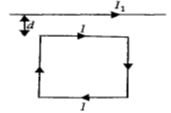
$F_{1}=\frac{\mu_{0} I_{1} \Pi}{2 \pi d l}$
$F_{2}=\frac{\mu_{0} I_{1} I}{2 \pi(d+l)}$
$F_{1}>F_{3}$
$F_{n e t}=F_{1}-F_{3}$
So, wire attract loop.
Generate a complete, print-ready paper with questions like this in minutes — across 16+ boards, with answer keys.
$\left(\mathrm{hc}=1240\; \mathrm{eV} \mathrm{nm}, 1\; \mathrm{eV}=1.6 \times 10^{-19} \;\mathrm{J}\right)$
$A:$ The width of the depletion layer in a $P-N$ junction diode increases in forwards bias
$B:$In an intrinsic semiconductor the fermi energy level is exactly in the middle of the forbidden gap