MCQ
A square planar complex is formed by hybridisation of which atomic orbitals
- A$s,\,\,{p_x},\,\,{p_y},\,\,{d_{yz}}$
- ✓$s,\,\,{p_x},\,\,{p_y},\,\,{d_{{x^2} - {y^2}}}$
- C$s,\,\,{p_x},\,\,{p_{y,\,\,}}{d_{{z^2}}}$
- D$s,\,\,{p_y},\,\,{p_z},{d_{xy}}$
Generate a complete, print-ready paper with questions like this in minutes — across 16+ boards, with answer keys.
${H_2}(g) + \frac{1}{2}{O_2}(g) \to {H_2}O(g)$ is $\Delta {H_1}$ and that of
${H_2}(g) + \frac{1}{2}{O_2}(g) \to {H_2}O(l)$ is $\Delta {H_2}$. Then
Statement $-I :$ Retardation factor $\left( R _{ f }\right)$ can be measured in meter/centimeter.
Statement $-II :$ $R _{ f }$ value of a compound remains constant in all solvents.
Choose the most appropriate answer from the options given below
$\begin{array}{*{20}{c}}{ - OAc}\\{\rm{I}}\end{array}$$\begin{array}{*{20}{c}}{ - OMe}\\{{\rm{II}}}\end{array}$$\begin{array}{*{20}{c}}{ - OS{O_2}Me}\\{{\rm{III}}}\end{array}$$\begin{array}{*{20}{c}}{ - OS{O_2}C{F_3}}\\{{\rm{IV}}}\end{array}$
The order of leaving group ability is
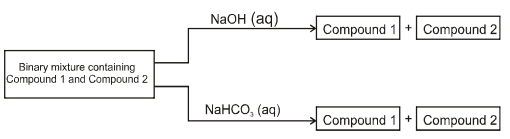
$(A)$ $C _6 H _5 OH$ and $C _6 H _5 COOH$
$(B)$ $C _6 H _5 COOH$ and $C _6 H _5 CH _2 OH$
$(C)$ $C _6 H _5 CH _2 OH$ and $C _6 H _5 OH$
$(D)$ $C _6 H _5 CH _2 OH$ and $C _6 H _5 CH _2 COOH$