MCQ
A square wire frame of size L is dipped in a liquid. On taking out, a membrane is formed. If the surface tension of liquid is T, force acting on the frame will be
  • A
    2 TL
  • B
    10 TL
  • C
    4 TL
  • D
    8 TL

Need a full question paper?

Generate a complete, print-ready paper with questions like this in minutes — across 16+ boards, with answer keys.
Start Generating Free

Similar questions

Newton's first law is applicable
A body $A$ of mass $M$ while falling vertically downwards under gravity breaks into two parts; a body $B$ of mass $\frac{2}{3} M$. The centre of mass of bodies $B$ and $C$ taken together shifts compared to that of body $A$ towards
When a tuning fork of frequency $341$ is sounded with another tuning fork, six beats per second are heard. When the second tuning fork is loaded with wax and sounded with the first tuning fork, the number of beats is two per second. The natural frequency of the second tuning fork is
A force of magnitude of $30\, N$ acting along $\hat i + \hat j + \hat k$ , displaces a particle from point $(2, 4, 1)$ to $(3, 5, 2)$ . The work done during this displacement is
The radii of two planets $A$ and $B$ are $R$ and $4 R$ and their densities are $\rho$ and $\rho / 3$ respectively. The ratio of acceleration due to gravity at their surfaces $\left(g_A: g_B\right)$ will be
A metallic wire of length $L$ is fixed between two rigid supports. If the wire is cooled through a temperature difference $\Delta T$ ($Y$ = young’s modulus, $\rho$ = density, $\alpha$ = coefficient of linear expansion) then the frequency of transverse vibration is proportional to : 
The air density at Mount Everest is less than that at the sea level. It is found by mountaineers that for one trip lasting a few hours, the extra oxygen needed by them corresponds to $30,000\, cc$ at sea level (pressure $1$ atmosphere, temperature $27°C$). Assuming that the temperature around Mount Everest is $-73°C$ and that the oxygen cylinder has capacity of $5.2 \,litre,$ the pressure at which ${O_2}$ be filled (at site) in cylinder is  .... $atm$
One mole of a gas obeying the equation of state $P(V-b)=R T$ is made to expand from a state with coordinates $\left(P_{1}, V_{1}\right)$ to a state with $\left(P_{2}, V_{2}\right)$ along a process that is depicted by a straight line on a $P-V$ diagram. Then, the work done is given by
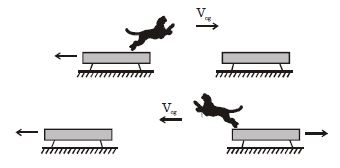
A strange cat with a mass $m_c$ is sitting at rest on the left plank of a pair of identical planks. Each plank has mass $m_s$ and they rest on frictionless ice. Suddenly, the cat leaps to the right plank, traveling with a horizontal speed $v_{cg}$ measured with respect to the ground. The instant the cat reaches the right plank, it turns around and leaps back to the left plank. The horizontal component of the cat’s speed is again $v_{cg}$ measured with respect to the ground. The final speed of right plank in terms of the masses of the cat and planks and the cat’s leaping speed is (The cat remains on the left plank after its return).
Three closed vessels $A, B$ and $C$ are at the same temperature $T$ and contain gases which obey the Maxwellian distribution of velocities. Vessel $A$ contains only ${O_2},\,B$ only ${N_2}$ and $C$ a mixture of equal quantities of ${O_2}$ and ${N_2}$. If the average speed of the ${O_2}$ molecules in vessel A is ${V_1}$, that of the ${N_2}$ molecules in vessel B is ${V_2}$, the average speed of the ${O_2}$ molecules in vessel $C$ is