MCQ
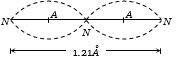
A standing wave having $3$ nodes and $2$ antinodes is formed between two atoms having a distance $1.21\;\mathring A$ between them. The wavelength of the standing wave is .... $\mathop A\limits^o $
  • $1.21$
  • B
    $2.42 $
  • C
    $6.05$
  • D
    $3.63 $

Answer

Correct option: A.
$1.21$
a
(a) $\lambda = 1.21{Å}$

Need a full question paper?

Generate a complete, print-ready paper with questions like this in minutes — across 16+ boards, with answer keys.
Start Generating Free

Similar questions

Melting point of ice
One mole of an ideal gas expands adiabatically from an initial state $\left(T_A, V_0\right)$ to final state $\left(T_f, 5 V_0\right)$. Another mole of the same gas expands isothermally from a different initial state ( $T_{\mathrm{B}}, \mathrm{V}_0$ ) to the same final state $\left(T_{\mathrm{f}}, 5 V_0\right)$. The ratio of the specific heats at constant pressure and constant volume of this ideal gas is $\gamma$. What is the ratio $T_{\mathrm{A}} / T_{\mathrm{B}}$ ?
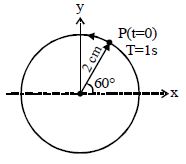
Figure shows the circular motion of a particle. The radius of the circle, the period, sense of revolution and the initial position are indicated in the figure. The simple harmonic motion of the $x-$ projection of the radius vector of the rotating particle $P$ is
Two equal positive point charges are separated by a distance $2 a$. The distance of a point from the centre of the line joining two charges on the equatorial line (perpendicular bisector) at which force experienced by a test charge $q_0$ becomes maximum is $\frac{a}{\sqrt{x}}$. The value of $x$ is $................$
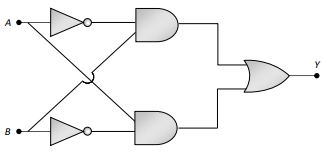
The combination of the gates shown will produce
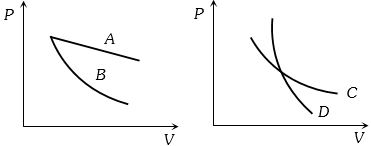
In the following figure, four curves $A, B, C$ and $D$ are shown. The curves are
A ray of monochromatic light suffers minimum deviation of ${38^o}$ while passing through a prism of refracting angle ${60^o}$. Refractive index of the prism material is
A magnet of total magnetic moment ${10\,^{ - 2}}\hat i\,A - {m^2}$ is placed in a time varying magnetic field, $B\,\hat i\,\left( {\cos \,\omega t} \right)$ where $B = 1\, Tesla$ and $\omega  = 0.125\, rad/s$. The work done for reversing the direction of the magnetic moment at $t = 1\, second$, is
In a triclinic crystal system
A stream of photons having energy $3 \,eV$ each impinges on a potassium surface. The work function of potassium is $2.3 \,eV$. The emerging photo-electrons are slowed down by a copper plate placed $5 \,mm$ away. If the potential difference between the two metal plates is $1 \,V$, the maximum distance the electrons can move away from the potassium surface before being turned back is .......... $mm$