Question
A standing wave is represented by $\text{y}=2\text{A}\sin\text{kx}\cos\omega\text{t}.$ If one of the component waves is $\text{y}_1=\text{A}\sin(\omega\text{t}-\text{kx}),$ what is the equation of the second component wave?

Answer

As $2\sin\text{A}\cos\text{B}=\sin(\text{A}+\text{B})+\sin(\text{A}-\text{B})$
$\text{y}=2\text{A}\sin\text{kx}\cos\omega\text{t}$
$\text{A}\sin(\text{kx}+\omega\text{t})+\text{A}\sin(\text{kx}-\omega\text{t})$
According to superposition principle,
$\text{y}=\text{y}_1+\text{y}_2;$
and $\text{y}_1=\text{A}\sin(\omega\text{t}-\text{kx})=-\text{A}\sin(\text{kx}-\omega\text{t})$
$\therefore \text{y}_2=\text{y}-\text{y}_1=2\text{A}\sin\text{kx}\cos\omega\text{t}+\text{A}\sin(\text{kx}-\omega\text{t})$
$=\text{A}\sin(\text{kx}+\omega\text{t})+2\text{A}\sin(\text{kx}-\omega\text{t})$
$=\text{a}\sin(\text{kx}+\omega\text{t})-2\text{A}\sin(\omega\text{t}-\text{kx}).$

Need a full question paper?

Generate a complete, print-ready paper with questions like this in minutes — across 16+ boards, with answer keys.
Start Generating Free

Similar questions

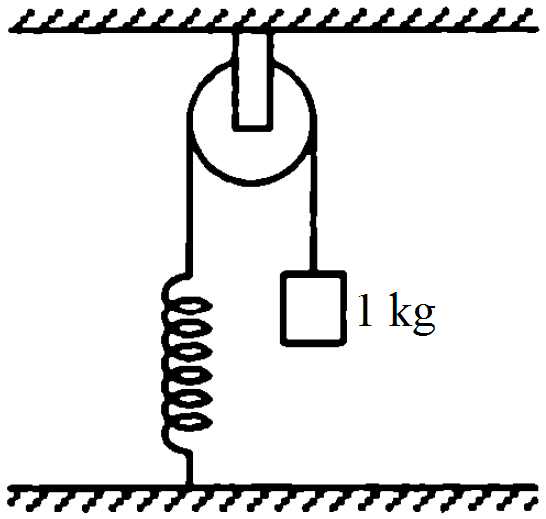
The pulley shown in figure has a radius of $20cm$ and moment of inertia $0.2kg-m^2$. The string going over it is attached at one end to a vertical spring of spring constant $50N/m$ fixed from below, and supports a $1kg$ mass at the other end. The system is released from rest with the spring at its natural length. Find the speed of the block when it has descended through $10cm$. Take $g = 10m/s^2​​​​​​​$.
It is found that photosynthesis starts in certain plants when exposed to the sunlight but it does not start if the plant is exposed only to infrared light. Explain.
The gravitational potential energy of a two particle system is derived in this chapter as $\text{U}=-\frac{\text{Gm}_1\text{m}_2}{\text{r}}.$ Does it follow from this equation that the potential energy for $\text{r}=\infty$ must be zero? Can we choose the potential energy for $\text{r}=\infty.$ to be 20J and still use this formula? If no, what formula should be used to calculate the gravitational potential energy at separation r?
A force of $10^6 \mathrm{Nm}^{-2}$ is required for breaking a material. If the density of the material is $3 \times 10^3 \mathrm{~kg} / \mathrm{m}^{-3}$, then what should be the length of the wire made of material so that it breaks by its own weight?
Why is it not possible to make permanent magnets from paramagnetic materials?
Just as precise measurements are necessary in science, it is equally important to be able to make rough estimates of quantities using rudimentary ideas and common observations. Think of ways by which you can estimate the following (where an estimate is difficult to obtain, try to get an upper bound on the quantity): The mass of an elephant.
A bus starts with a constant acceleration $1\ ms^{-2}$. At the same time a car moving with a constant velocity of $5\ ms^{-1}$ overtakes the bus.
  1. How far from the starting point, the bus overtakes the car.
  2. How fast the bus was moving at the time of overtake?
The current in a long solenoid of radius $R$ and having $n$ turns per unit length is given by $\text{i}=\text{i}_0\sin\omega\text{t}.$ A coil having $N$ turns is wound around it near the centre. Find
  1. The induced $\text{emf}$ in the coil.
  2. The mutual inductance between the solenoid and the coil.
In Exercises $3.13$ and $3.14$, we have carefully distinguished between average speed and magnitude of average velocity. No such distinction is necessary when we consider instantaneous speed and magnitude of velocity. The instantaneous speed is always equal to the magnitude of instantaneous velocity. Why?
Calculate the speed of sound in a gas in which two waves of wavelengths 1.00m and 1.01m produce 10 beats in 3 seconds.