Question
A stationary charge produces only an electrostatic field while a charge in uniform motion produces a magnetic field, that does not change with time. An oscillating charge is an example of accelerating charge. It produces an oscillating magnetic field, which in turn produces an oscillating electric fields and so on. The oscillating electric and magnetic fields regenerate each other as a wave which propagates through space.

Magnetic field in a plane electromagnetic wave is given by $\vec{\text{B}}=\text{B}_0\sin(\text{kx}+\omega\text{t}) \hat{\text{j}}\text{T}.$
  1. Expression for corresponding electric field will be (Where c is speed of light).
  1. $\vec{\text{E}}=-\text{B}_0\text{c}\sin(\text{kx}+\omega\text{t}) \hat{\text{k}}\frac{\text{V}}{\text{m}}$
  2. $\vec{\text{E}}=\text{B}_0\text{c}\sin(\text{kx}-\omega\text{t}) \hat{\text{k}}\frac{\text{V}}{\text{m}}$
  3. $\vec{\text{E}}=\frac{\text{B}_0}{\text{c}}\sin(\text{kx}+\omega\text{t}) \hat{\text{k}}\frac{\text{V}}{\text{m}}$
  4. $\vec{\text{E}}=\text{B}_0\text{c}\sin(\text{kx}+\omega\text{t}) \hat{\text{k}}\frac{\text{V}}{\text{m}}$
  1. The electric field component ofa monochromatic radiation is given by $\vec{\text{E}} = 2\in_0\hat{\text{i}}\cos\text{kz}\cos\omega\text{t}.$ Its magnetic field $\vec{\text{B}}$ is then given by:
  1. $\frac{2\in_0}{\text{c}}\hat{\text{j}}\cos\text{kz}\cos\omega\text{t}$
  2. $\frac{2\in_0}{\text{c}}\hat{\text{j}}\sin\text{kz}\cos\omega\text{t}$
  3. $\frac{2\in_0}{\text{c}}\hat{\text{j}}\sin\text{kz}\sin\omega\text{t}$
  4. $-\frac{2\in_0}{\text{c}}\hat{\text{j}}\sin\text{kz}\sin\omega\text{t}$
  1. A plane em wave of frequency 25MHz travels in a free space along x-direction. At a particular point in space and time, $\text{E}=(6.3\ \hat{\text{j}})\frac{\text{V}}{\text{m}}.$ What is magnetic field at that time?
  1. $0.095\mu\text{T}$
  2. $0.124\mu\text{T}$
  3. $0.089\mu\text{T}$
  4. $0.021\mu\text{T}$
  1. A plane electromagnetic wave travelling along the x-direction has a wavelength of 3mm. The variation in the electric field occurs in they-direction with an amplitude 66Vm1. The equations for the electric and magnetic fields as a function of x and tare respectively.
  1. $\text{E}_\text{y}=33\cos\pi\times10^{11}\Big(\text{t}-\frac{\text{x}}{\text{c}}\Big),\\\text{B}_\text{z}=1.1\times10^{-7}\cos\pi\times10^{11}\Big(\text{t}-\frac{\text{x}}{\text{c}}\Big)$
  2. $\text{E}_\text{y}=11\cos2\pi\times10^{11}\Big(\text{t}-\frac{\text{x}}{\text{c}}\Big),\\\text{B}_\text{y}=11\times10^{-7}\cos2\pi\times10^{11}\Big(\text{t}-\frac{\text{x}}{\text{c}}\Big)$
  3. $\text{E}_\text{x}=33\cos\pi\times10^{11}\Big(\text{t}-\frac{\text{x}}{\text{c}}\Big),\\\text{B}_\text{x}=11\times10^{-7}\cos\pi\times10^{11}\Big(\text{t}-\frac{\text{x}}{\text{c}}\Big)$
  4. $\text{E}_\text{y}=66\cos2\pi\times10^{11}\Big(\text{t}-\frac{\text{x}}{\text{c}}\Big),\\\text{B}_\text{z}=2.2\times10^{-7}\cos2\pi\times10^{11}\Big(\text{t}-\frac{\text{x}}{\text{c}}\Big)$
  1. A plane electromagnetic wave travels in free space along x-axis. At a particular point in space, the electric field along y-axis is 9.3Vm-1. The magnetic induction (B) alongz-axis is:
  1. 3.1 × 10-8T
  2. 3 × 10⁻⁵T
  3. 3 × 10⁻⁶T
  4. 9.3 × 10-6T

Answer

  1. (d) $\vec{\text{E}}=\text{B}_0\text{c}\sin(\text{Kx}+\omega\text{t}) \hat{\text{k}}\frac{\text{V}}{\text{m}}$

Explanation:

Given: $\vec{\text{B}}=\text{B}_0\text{c}\sin(\text{Kx}+\omega\text{t}) \hat{\text{k}}\frac{\text{V}}{\text{m}}$

The relation between electric and magnetic field is,

$\text{c}=\frac{\text{E}}{\text{B}}$ or E = cB

The electric 6 eld component is perpendicular to the direction of propagation and the direction of magnetic field. Therefore, the electric field component along z-axis is obtained as $\vec{\text{E}}=\text{cB}_0\sin(\text{kx}+\omega\text{t}) \hat{\text{k}}\frac{\text{V}}{\text{m}}.$

  1. (c) $\frac{2\in_0}{\text{c}}\hat{\text{j}}\sin\text{kz}\sin\omega\text{t}$

Explanation:

$\frac{\text{dE}}{\text{dz}}=-\frac{\text{dB}}{\text{dt}}$

$\frac{\text{dE}}{\text{dz}}=-2\text{E}_0\text{k}\sin\text{kz}\cos\omega\text{t}=-\frac{\text{dB}}{\text{dt}}$

${\text{dB}}=+2\text{E}_0\text{k}\sin\text{kz}\cos\omega\text{t}{\text{dt}}$

${\text{B}}=+2\text{E}_0\text{k}\sin\text{kz}\int\cos\omega\text{t}{\text{dt}}$

$=+2\text{E}_0\frac{\text{k}}{\omega}\sin\text{kz}\sin\omega\text{t}$

$\frac{\text{E}_0}{\text{B}_0}=\frac{\omega}{\text{k}}=\text{c}$

$\text{B}=\frac{2\text{E}_0}{\text{c}}\sin\text{kz}\sin\omega\text{t}$

$\therefore\text{B}=\frac{2\text{E}_0}{\text{c}}\sin\text{kz}\sin\omega\text{t}\hat{\text{j}}$

E is along y-direction and the wave propagates along x-axis.

$\therefore$ B should be in a direction perpendicular to both x and y-axis.

  1. (d) $0.021\mu\text{T}$

Explanation:

Here, $\vec{\text{E}}=6.3\hat{\text{j}};\text{c}=3\times10^8\frac{\text{m}}{\text{s}}$

The magnitude of B is:

${\text{Bz}}=\frac{\text{E}}{\text{c}}=\frac{6.3}{3\times10^8}$

$=2.1\times10^8\ \text{T}=0.021\mu\text{T}$

  1. (d) $\text{E}_\text{y}=66\cos2\pi\times10^{11}\Big(\text{t}-\frac{\text{x}}{\text{c}}\Big),\text{B}_\text{z}=2.2\times10^{-7}\cos2\pi\times10^{11}\Big(\text{t}-\frac{\text{x}}{\text{c}}\Big)$

Explanation:

Here: $\text{E}_0=66\text{Vm}^{-1},\text{E}_\text{y}=66\cos\omega\Big(\text{t}-\frac{\text{x}}{\text{c}}\Big),$

$\lambda=3\text{mm}=3\times10^{-3}\text{m},\text{k}=\frac{2\pi}{\lambda}$

$\frac{\omega}{\text{k}}=\text{c}\Rightarrow\omega=\text{ck}=3\times10^8\times\frac{2\pi}{3\times10^{-3}}$

or $\omega=2\pi\times10^{11}$

$\therefore\text{E}_\text{y}=66\cos2\pi\times10^{11}\Big(\text{t}-\frac{\text{x}}{\text{c}}\Big)$

${\text{Bz}}=\frac{\text{E}_\text{y}}{\text{c}}=\Big(\frac{66}{3\times10^8}\Big)\cos2\pi\times10^{11}\Big(\text{t}-\frac{\text{x}}{\text{c}}\Big)$

$=2.2\times10^{-7}\cos2\pi\times10^{11}\Big(\text{t}-\frac{\text{x}}{\text{c}}\Big)$

  1. (a) 3.1 × 10-8T

Explanation:

At a particular point, E = 9.3Vm-1

$\therefore$ Magnetic field at the same point $=\frac{9.3}{3\times10^8}$

= 3.1 × 10-8T

Need a full question paper?

Generate a complete, print-ready paper with questions like this in minutes — across 16+ boards, with answer keys.

Start Generating Free

Similar questions

By mistake, an eye surgeon puts a concave lens in place of the lens in the eye after a cataract operation. Will the patient be able to see clearly any object placed at any distance?
Two submarines are approaching each other in a calm sea. The first submarine travels at a speed of 36km/h and the other at 54km/h relative to the water. The first submarine sends a sound signal (sound waves in water are also called sonar) at a frequency of 2000Hz.
  1. At what frequency is this signal received by the second submarine?
  2. The signal is reflected from the second submarine. At what frequency is this signal received by the first submarine. Take the speed of the sound wave in water to be 1500m/s.
Derive $\delta=i+e- A$ for a Prism. Also derive an expression for the refractive index of material of the Prism.
 For the past some time, Aarti had been observing some erratic body movement, unsteadiness and lack of coordination in the activities of her sister Radha, who also used to complain of severe headache occasionally. Aarti suggested to her parents to get a medical check-up of Radha. The doctor thoroughly examined Radha and diagnosed that she has a brain tumour.
  1. What, according to you, are the values displayed by Aarti?
  2. How can radioisotopes help a doctor to diagnose brain tumour? 
In motor vehicles, a convex mirror is attached near the driver's seat to give him the view of the traffic behind. What is the special function of this convex mirror which a plane mirror can not do?
When subatomic particles undergo reactions, energy is conserved, but mass is not necessarily conserved. However, a particle's mass “contributes” to its total energy, in accordance with Einstein's famous equation, E = mc2 In this equation, E denotes the energy carried by a particle because of its mass. The particle can also have additional energy due to its motion and its interactions with other particles. Consider a neutron at rest and well separated from other particles. It decays into a proton, an electron and an undetected third particle as given here: Neutron → proton + electron + ???

The given table summarizes some data from a single neutron decay. Electron volt is a unit of energy. Column 2 shows the rest mass of the particle times the speed of light squared.

Particle
Mass × c2 (MeV)
Kinetic energy (MeV)
Neutron
940.97
0.00
Proton
939.67
0.01
Electron
0.51
0.39
  1. From the given table, which properties of the undetected third particle can be calculate?
  1. Total energy, but not kinetic energy.
  2. Kinetic energy, but not total energy.
  3. Both total energy and kinetic energy.
  4. Neither total energy nor kinetic energy.
  1. Assuming the table contains no major errors, what can we conclude about the (mass × c2) of the undetected third particle?
  1. It is 0. 79 MeV
  2. It is 0.39 MeV
  3. It is less than or equal to 0.79 MeV; but we cannot be more precise.
  4. It is less than or equal to 0.40 MeV; but we cannot be more precise.
  1. Could this reaction occur?

Proton → neutron + other particles

  1. Yes, if the other particles have much more kinetic energy than mass energy.
  2. Yes, but only if the proton has potential energy (due to interactions with other particles). 
  3. No, because a neutron is more massive than a proton.
  4. No, because a proton is positively charged while a neutron is electrically neutral.
  1. How much mass has to be converted into energy to produce electric power of 500MW for one hour?
  1. 2 × 10-5kg
  2. 1 × 10⁻⁵kg
  3. 3 × 10⁻⁵kg
  4. 4 × 10⁻⁵kg
  1. The equivalent energy of 1g of substance is.
  1. 9 × 10¹³J
  2. 6 × 10¹²J
  3. 3 × 10¹³J
  4. 6 × 10¹³J

The nucleus was first discovered in 1911 by Lord Rutherford and his associates by experiments on scattering of $\alpha$-particles by atoms. He found that the scattering results could be explained, if atoms consist of a small, central, massive and positive core surrounded by orbiting electrons. The experimental results indicated that the size of the nucleus is of the order of 10-14m and is thus 10000 times smaller than the size of atom.

  1. Ratio of mass of nucleus with mass of atom is approximately.
  1. 1
  2. 10
  3. 103
  4. 1010
  1. Ratio of mass of nucleus with mass of atom is approximately.
  1. 1 : 2 : 3
  2. 1 : 1 : 1
  3. 1 : 1 : 2
  4. 1 : 2 : 4
  1. Nuclides with same neutron number but different atomic number are.
  1. Isobars
  2. Isotopes
  3. Isotones
  4. none of these
  1. If R is the radius and A is the mass number, then log R versus log A graph will be.
  1. A straight line
  2. A straight line
  3. An ellipse
  4. None of these.
  1. The ratio of the nuclear radii of the gold isotope $_{79}^{197}\text{Au}$ and silver isotope $_{47}^{107}\text{Au}$ is.
  1. 1.23
  2. 0.216
  3. 2.13
  4. 3.46
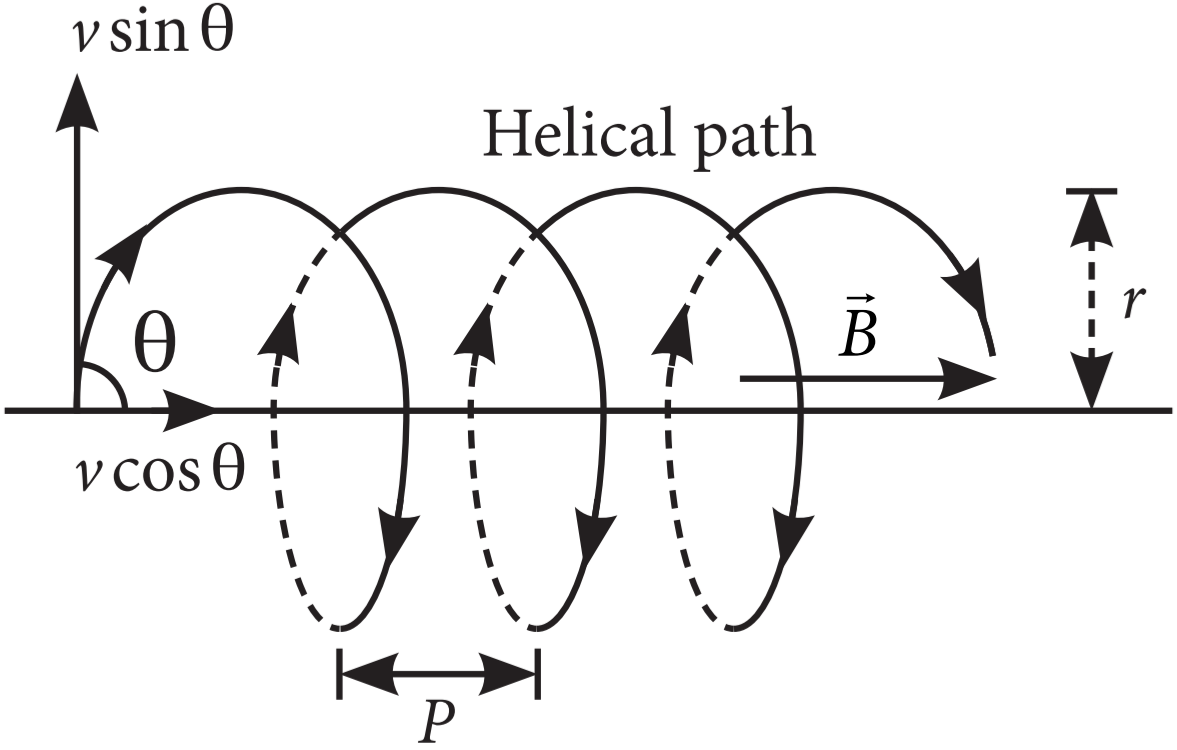
The path of a charged particle in magnetic field depends upon angle between velocity and magnetic field. If velocity $\vec{\text{v}}$ is at angle $\theta$ to $\vec{\text{B}},$ component of velocity parallel to magnetic field $(\text{v}\cos\theta)$ remains constant and component of velocity perpendicular to magnetic field $(\text{v}\sin\theta)$ is responsible for circular motion, thus the charge particle moves in a helical path.

The plane of the circle is perpendicular to the magnetic field and the axis of the helix is parallel to the magnetic field. The charged particle moves along helical path touching the line parallel to the magnetic field passing through the starting point after each rotation.

Radius of circular path is $\text{r}=\frac{\text{mv}\sin\theta}{\text{qB}}$

Hence the resultant path of the charged particle will be a helix, with its axis along the direction of $\vec{\text{B}}$ as shown in figure.

  1. When a positively charged particle enters into a uniform magnetic field with uniform velocity, its trajectory can b:
  1. A straight line.
  2. A circle.
  3. A helix.
  1. (i) Only
  2. (i) or (ii)
  3. (i) or (iii)
  4. Any one of (i), (ii) and (iii)
  1. Two charged particles A and B having the same charge, mass and speed enter into a magnetic field in such a way that the initial path of A makes an angle of 30º and that of B makes an angle of 90º with the field. Then the trajectory of:
  1. B will have smaller radius of curvature than that of A.
  2. Both will have the same curvature.
  3. A will have smaller radius of curvature than that of B.
  4. Both will move along the direction of their original velocities.
  1. An electron having momentum 2.4 × 10⁻²³kg m/ s enters a region of uniform magnetic field of 0.15T. The field vector makes an angle of 30º with the initial velocity vector of the electron. The radius of the helical path of the electron in the field shall be:
  1. mm
  2. 1mm
  3. $\frac{\sqrt{3}}{2}\text{mm}$

  4. 0.5mm
  1. The magnetic field in a certain region of space is given by $\vec{\text{B}}=8.35\times10^{-2}\hat{\text{i}}\text{T}.$ A proton is shot into the field with velocity $\vec{\text{v}}=(2\times10\hat{\text{i}}+4\times10^5\hat{\text{j}.}$ The proton follows a helical path in the field. The distance moved by proton in the x-direction during the period ofone revolution in the yz-plane will be:

(Mass of proton = 1.67 × 10⁻²⁷kg)

  1. 0.053m
  2. 0.136m
  3. 0.157m
  4. 0.236m
  1. The frequency of revolution of the particle is:
  1. $\frac{\text{m}}{\text{pB}}$

  2. $\frac{\text{qB}}{2\pi\text{m}}$

  3. $\frac{2\pi\text{R}}{\text{v}\cos\theta}$

  4. $\frac{2\pi\text{R}}{\text{v}\sin\theta}$ 

If an automobile engine is overheated, it is cooled by putting water on it. It is advised that the water should be put slowly with engine running. Explain the reason.
A beam of light converges at a point $P$. Now a lens is placed in the path of the convergent beam 12 cm from P. At what point does the beam converge if the lens is (a) a convex lens of focal length 20 cm , and (b) a concave lens of focal length 16 cm ?