Question
A stationary charge produces only an electrostatic field while a charge in uniform motion produces a magnetic field, that does not change with time. An oscillating charge is an example of accelerating charge. It produces an oscillating magnetic field, which in turn produces an oscillating electric fields and so on. The oscillating electric and magnetic fields regenerate each other as a wave which propagates through space.

Magnetic field in a plane electromagnetic wave is given by $\vec{\text{B}}=\text{B}_0\sin(\text{kx}+\omega\text{t}) \hat{\text{j}}\text{T}.$
  1. Expression for corresponding electric field will be (Where c is speed of light).
  1. $\vec{\text{E}}=-\text{B}_0\text{c}\sin(\text{kx}+\omega\text{t}) \hat{\text{k}}\frac{\text{V}}{\text{m}}$
  2. $\vec{\text{E}}=\text{B}_0\text{c}\sin(\text{kx}-\omega\text{t}) \hat{\text{k}}\frac{\text{V}}{\text{m}}$
  3. $\vec{\text{E}}=\frac{\text{B}_0}{\text{c}}\sin(\text{kx}+\omega\text{t}) \hat{\text{k}}\frac{\text{V}}{\text{m}}$
  4. $\vec{\text{E}}=\text{B}_0\text{c}\sin(\text{kx}+\omega\text{t}) \hat{\text{k}}\frac{\text{V}}{\text{m}}$
  1. The electric field component ofa monochromatic radiation is given by $\vec{\text{E}} = 2\in_0\hat{\text{i}}\cos\text{kz}\cos\omega\text{t}.$ Its magnetic field $\vec{\text{B}}$ is then given by:
  1. $\frac{2\in_0}{\text{c}}\hat{\text{j}}\cos\text{kz}\cos\omega\text{t}$
  2. $\frac{2\in_0}{\text{c}}\hat{\text{j}}\sin\text{kz}\cos\omega\text{t}$
  3. $\frac{2\in_0}{\text{c}}\hat{\text{j}}\sin\text{kz}\sin\omega\text{t}$
  4. $-\frac{2\in_0}{\text{c}}\hat{\text{j}}\sin\text{kz}\sin\omega\text{t}$
  1. A plane em wave of frequency 25MHz travels in a free space along x-direction. At a particular point in space and time, $\text{E}=(6.3\ \hat{\text{j}})\frac{\text{V}}{\text{m}}.$ What is magnetic field at that time?
  1. $0.095\mu\text{T}$
  2. $0.124\mu\text{T}$
  3. $0.089\mu\text{T}$
  4. $0.021\mu\text{T}$
  1. A plane electromagnetic wave travelling along the x-direction has a wavelength of 3mm. The variation in the electric field occurs in they-direction with an amplitude 66Vm1. The equations for the electric and magnetic fields as a function of x and tare respectively.
  1. $\text{E}_\text{y}=33\cos\pi\times10^{11}\Big(\text{t}-\frac{\text{x}}{\text{c}}\Big),\\\text{B}_\text{z}=1.1\times10^{-7}\cos\pi\times10^{11}\Big(\text{t}-\frac{\text{x}}{\text{c}}\Big)$
  2. $\text{E}_\text{y}=11\cos2\pi\times10^{11}\Big(\text{t}-\frac{\text{x}}{\text{c}}\Big),\\\text{B}_\text{y}=11\times10^{-7}\cos2\pi\times10^{11}\Big(\text{t}-\frac{\text{x}}{\text{c}}\Big)$
  3. $\text{E}_\text{x}=33\cos\pi\times10^{11}\Big(\text{t}-\frac{\text{x}}{\text{c}}\Big),\\\text{B}_\text{x}=11\times10^{-7}\cos\pi\times10^{11}\Big(\text{t}-\frac{\text{x}}{\text{c}}\Big)$
  4. $\text{E}_\text{y}=66\cos2\pi\times10^{11}\Big(\text{t}-\frac{\text{x}}{\text{c}}\Big),\\\text{B}_\text{z}=2.2\times10^{-7}\cos2\pi\times10^{11}\Big(\text{t}-\frac{\text{x}}{\text{c}}\Big)$
  1. A plane electromagnetic wave travels in free space along x-axis. At a particular point in space, the electric field along y-axis is 9.3Vm-1. The magnetic induction (B) alongz-axis is:
  1. 3.1 × 10-8T
  2. 3 × 10⁻⁵T
  3. 3 × 10⁻⁶T
  4. 9.3 × 10-6T

Answer

  1. (d) $\vec{\text{E}}=\text{B}_0\text{c}\sin(\text{Kx}+\omega\text{t}) \hat{\text{k}}\frac{\text{V}}{\text{m}}$

Explanation:

Given: $\vec{\text{B}}=\text{B}_0\text{c}\sin(\text{Kx}+\omega\text{t}) \hat{\text{k}}\frac{\text{V}}{\text{m}}$

The relation between electric and magnetic field is,

$\text{c}=\frac{\text{E}}{\text{B}}$ or E = cB

The electric 6 eld component is perpendicular to the direction of propagation and the direction of magnetic field. Therefore, the electric field component along z-axis is obtained as $\vec{\text{E}}=\text{cB}_0\sin(\text{kx}+\omega\text{t}) \hat{\text{k}}\frac{\text{V}}{\text{m}}.$

  1. (c) $\frac{2\in_0}{\text{c}}\hat{\text{j}}\sin\text{kz}\sin\omega\text{t}$

Explanation:

$\frac{\text{dE}}{\text{dz}}=-\frac{\text{dB}}{\text{dt}}$

$\frac{\text{dE}}{\text{dz}}=-2\text{E}_0\text{k}\sin\text{kz}\cos\omega\text{t}=-\frac{\text{dB}}{\text{dt}}$

${\text{dB}}=+2\text{E}_0\text{k}\sin\text{kz}\cos\omega\text{t}{\text{dt}}$

${\text{B}}=+2\text{E}_0\text{k}\sin\text{kz}\int\cos\omega\text{t}{\text{dt}}$

$=+2\text{E}_0\frac{\text{k}}{\omega}\sin\text{kz}\sin\omega\text{t}$

$\frac{\text{E}_0}{\text{B}_0}=\frac{\omega}{\text{k}}=\text{c}$

$\text{B}=\frac{2\text{E}_0}{\text{c}}\sin\text{kz}\sin\omega\text{t}$

$\therefore\text{B}=\frac{2\text{E}_0}{\text{c}}\sin\text{kz}\sin\omega\text{t}\hat{\text{j}}$

E is along y-direction and the wave propagates along x-axis.

$\therefore$ B should be in a direction perpendicular to both x and y-axis.

  1. (d) $0.021\mu\text{T}$

Explanation:

Here, $\vec{\text{E}}=6.3\hat{\text{j}};\text{c}=3\times10^8\frac{\text{m}}{\text{s}}$

The magnitude of B is:

${\text{Bz}}=\frac{\text{E}}{\text{c}}=\frac{6.3}{3\times10^8}$

$=2.1\times10^8\ \text{T}=0.021\mu\text{T}$

  1. (d) $\text{E}_\text{y}=66\cos2\pi\times10^{11}\Big(\text{t}-\frac{\text{x}}{\text{c}}\Big),\text{B}_\text{z}=2.2\times10^{-7}\cos2\pi\times10^{11}\Big(\text{t}-\frac{\text{x}}{\text{c}}\Big)$

Explanation:

Here: $\text{E}_0=66\text{Vm}^{-1},\text{E}_\text{y}=66\cos\omega\Big(\text{t}-\frac{\text{x}}{\text{c}}\Big),$

$\lambda=3\text{mm}=3\times10^{-3}\text{m},\text{k}=\frac{2\pi}{\lambda}$

$\frac{\omega}{\text{k}}=\text{c}\Rightarrow\omega=\text{ck}=3\times10^8\times\frac{2\pi}{3\times10^{-3}}$

or $\omega=2\pi\times10^{11}$

$\therefore\text{E}_\text{y}=66\cos2\pi\times10^{11}\Big(\text{t}-\frac{\text{x}}{\text{c}}\Big)$

${\text{Bz}}=\frac{\text{E}_\text{y}}{\text{c}}=\Big(\frac{66}{3\times10^8}\Big)\cos2\pi\times10^{11}\Big(\text{t}-\frac{\text{x}}{\text{c}}\Big)$

$=2.2\times10^{-7}\cos2\pi\times10^{11}\Big(\text{t}-\frac{\text{x}}{\text{c}}\Big)$

  1. (a) 3.1 × 10-8T

Explanation:

At a particular point, E = 9.3Vm-1

$\therefore$ Magnetic field at the same point $=\frac{9.3}{3\times10^8}$

= 3.1 × 10-8T

Need a full question paper?

Generate a complete, print-ready paper with questions like this in minutes — across 16+ boards, with answer keys.

Start Generating Free

Similar questions

In the year 1939, German scientist Otto Hahn and Strassmann discovered that when an uranium isotope was bombarded with a neutron, it breaks into two intermediate mass fragments. It was observed that, the sum of the masses of new fragments formed were less than the mass of the original nuclei. This difference in the mass appeared as the energy released in the process. Thus, the phenomenon of splitting of a heavy nucleus (usually A > 230) into two or more lighter nuclei by the bombardment of proton, neutron $\alpha$-particle, etc. with liberation of energy is called nuclear fission.
$\ _{92}\text{U}^{235}+\ _0\text{n}^{1}\rightarrow_{92}\text{U}^{236} \rightarrow\ _{56}\text{B}^{114}+\ _{36}\text{Kr}^{89}\ +3\ _{0}\text{n}^{1} + \text{Q}$
$\big[\because \ _{92}\text{U}^{236}= \text{Unstable nucleus}\big]$
  1. Nuclear fission can be explained on the basis of.
  1. Millikan's oil drop method
  2. Liquid drop model
  3. Shell model
  4. Bohr's model.
  1. For sustaining the nuclear fission chain reaction in a sample (of small size) of $_{92}^{235}\text{U}$ it is desirable to slow down fast neutrons by.
  1. Friction
  2. Elastic damping/ scattering
  3. Absorption
  4. None of these.
  1. Which of the following is/ are fission reaction(s)?
  1. $_0^1\text{n}\ +\ _{92}^{235}\text{U}\rightarrow\ _{92}^{235}\text{U}\rightarrow\ _{51}^{133}\text{Sb}+\ _{41}^{99}\text{nb}+\ 4_1^0\text{n}$
  2. $_0^1\text{n}\ +\ _{92}^{235}\text{U}\rightarrow\ _{54}^{1.40}\text{Xe}+\ _{38}^{94}\text{Sr}\ +2_0^1\text{n}$
  3. $_1^2\text{H}\ +\ _1^2\text{H}\rightarrow\ _2^3\text{He}+\ _0^1\text{n}$
  1. Both II and III
  2. Both I and III
  3. Only II
  4. Both I and II
  1. On an average, the number of neutrons and the energy of a neutron released per fission of a uranium atom are respectively.
  1. 2.5 and 2 keV
  2. 3 and 1 keV
  3. 2.5 and 2 MeV
  4. 2 and 2 keV
  1. In any fission process, ratio of mass of daughter nucleus to mass of parent nucleus is.
  1. Less than I
  2. Greater than I
  3. Equal to I
  4. Depends o the mass of parent nucleus.
Derive the formula of electric potential at a point due to electric dipole.
The absolute temperature of air in a region linearly increases from T1 to T2 in a space of width d. Find the time taken by a sound wave to go through the region in terms of T1, T2, d and the speed v of sound at 273K. Evaluate this time for T1 = 280K, T2 = 310K, d = 33m and v = 330m/s.
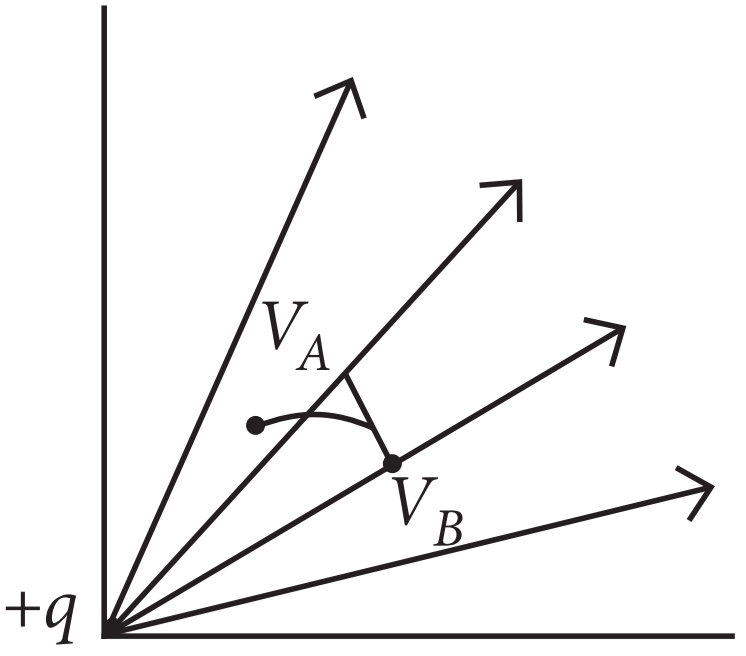
Electrostatic potential energy of a system of point charges is defined as the total amount of work done in bringing the different charges to their respective positions from infinitely charge mutual separations. The work is stored in the system of two point charges in the form of electrostatic potential energy U of the system. Electric potential difference between any points A and B in an electric field is the amount of work done in moving a unit positive test charge from A to B along any path agents the electrostatic force $\text{V}_\text{B}-\text{V}_\text{A}=\frac{\text{W}_\text{AB}}{\text{q}_\text{o}}=\int\vec{\text{E}}.\text{dl}.$

  1. A test charge is moved from lower potential point to a higher potential point. The potential energy of test charge wiII.
  1. Remain the same.
  2. Increase.
  3. Decrease.
  4. Become zero.
  1. Which of the following statement is not true?
  1. Electrostatic force is a conservative force.
  2. Potential energy of charge q at a point is the work done per unit charge in bringing a charge from any point to infinity.
  3. Spring force and gravitational force are conservative force.
  4. Both (a) and (c).
  1. Work done in moving a charge from one point to another inside a uniformly charged conducting sphere is:
  1. Always zero.
  2. Non-zero.
  3. May be zero.
  4. None of these.
  1. The work done in bringing a unit positive charge from infinite distance to a point at distance x from a positive charge Q is W. Then the potential $\phi$ at that point is:
  1. $\frac{\text{WQ}}{\text{x}}$

  2. W

  3. $\frac{\text{W}}{\text{x}}$

  4. WQ

  1. If $1\mu\text{C}$ charge is shifted from A to B and it is found that work done by an external force is $40\mu\text{J}.$ ln doing so against electrostatics force, the potential difference VA - VB is:
  1. 40V
  2. -40V
  3. 20V
  4. -60V
Currents can be induced not only in conducting coils, but also in conducting sheets or blocks. Current is induced in solid metallic masses when the magnetic flux threading through them changes. Such currents flow in the from of irregularly shaped loops throughout the body of the metal. These currents look like eddies or whirlpools in water so they are known as eddy currents. Eddy currents have both undesirable effects and practically useful applications. For example it causes unnecessary heating and wastage of power in electric motors, dynamos and in the cores of transformers.
  1. The working of speedometers of trains is based on:
  1. Wattless currents.
  2. Eddy currents.
  3. alternating currents.
  4. pulsating currents.
  1. Identify the wrong statement.
  1. Eddy currents are produced in a steady magnetic field.
  2. Induction furnace uses eddy currents to produce heat.
  3. Eddy currents can be used to produce braking force in moving trains.
  4. Power meters work on the principle of eddy currents.
  1. Which of the following is the best method to reduce eddy currents?
  1. Laminating core.
  2. Using thick wires.
  3. By reducing hysteresis loss.
  4. None of these.
  1. The direction of eddy currents is given by:
  1. Fleming's left hand rule.
  2. Biot-Savart law.
  3. Lenz's law
  4. Ampere-circuital law.
  1. Eddy currents can be used to heat localised tissues of the human body. This branch of medical therapy is called:
  1. Hyperthermia.
  2. Diathermy.
  3. Inductothermy.
  4. None of these.
Draw a graph showing the change in potential corresponding to the change in distance from a point charge. For the charged system shown in the figure, prove that the potential difference between points $A$ and $B$ is
Image
A slide projector has to project a 35mm slide (35mm × 23mm) on a 2m × 2m screen at a distance of 10m from the lens. What should be the focal length of the lens in the projector?
The household supply of electricity is at 220V (rms value) and 50Hz. Find the peak voltage and the least possible time in which the voltage can change from the rms value to zero.
On a winter day when the atmospheric temperature drops to -10°C, ice forms on the surface of a lake.
  1. Calculate the rate of increase of thickness of the ice when 10cm of ice is already formed.
  2. Calculate the total time taken in forming 10cm of ice. Assume that the temperature of the entire water reaches 0°C before the ice starts forming. Density of water = 1000kgm-3, latent heat of fusion of ice $=3.36\times10^5\text{Jkg}^{-1}$ and thermal conductivity of ice $=1.7\text{Wm}^{-1}{^{\circ}}\text{C}^{-1}.$ Neglect the expansion of water on freezing.
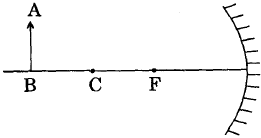
An object AB is kept in front of a concave mirror as shown in the figure.

  1. Complete the ray diagram showing the image formation of the object.
  2. How will the position and intensity of the image be affected if the lower half of the mirror's reflecting surface is painted black?