MCQ
A stationary horizontal disc is free to rotate about its axis. When a torque is applied on it, its kinetic energy as a function of $\theta ,$ where $\theta $ is the angle by which it has rotated, is given as $k\theta ^2.$ If its moment of inertia is $I$ then the angular acceleration of the disc is
  • A
    $\frac {K}{I}\,\theta $
  • B
    $\frac {K}{2I}\,\theta $
  • C
    $\frac {K}{4I}\,\theta $
  • $\frac {2K}{I}\,\theta $

Answer

Correct option: D.
$\frac {2K}{I}\,\theta $
d
$Kinetic\,energy\,KE = \frac{1}{2}I{\omega ^2} = K{\theta ^2}$

$ \Rightarrow {\omega ^2} = \frac{{2k{\theta ^2}}}{I} \Rightarrow \omega  = \sqrt {\frac{{2k}}{I}} \theta \,\,\,\,\,\,\,\,\,\,\,...\left( A \right)$

$Differentiate\,\left( A \right)\,wrt\,time\, \to $

$\frac{{d\omega }}{{dt}} = \alpha  = \sqrt {\frac{{2k}}{I}} \left( {\frac{{d\theta }}{{dt}}} \right)$

$ \Rightarrow \alpha  = \sqrt {\frac{{2k}}{I}} .\sqrt {\frac{{2k}}{I}} \,\theta \left\{ {by\,\left( 1 \right)} \right\}$

$ \Rightarrow \alpha  = \frac{{2k}}{I}\theta $

Need a full question paper?

Generate a complete, print-ready paper with questions like this in minutes — across 16+ boards, with answer keys.

Start Generating Free

Similar questions

A plane is in level flight at constant speed and each of its two wings has an area of $25 \;m ^{2}$ If the speed of the air is $180 \;km / h$ over the lower wing and $234\; km / h$ over the upper wing surface, determine the plane's mass in $kg$. (Take air density to be $1\; kg m ^{-3}$ ).
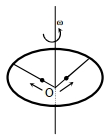
A ring of mass $M$ and radius $R$ is rotating with angular speed $\omega$ about a fixed vertical axis passing through its centre $O$ with two point masses each of mass $\frac{ M }{8}$ at rest at $O$. These masses can move radially outwards along two massless rods fixed on the ring as shown in the figure. At some instant the angular speed of the system is $\frac{8}{9} \omega$ and one of the masses is at a distance of $\frac{3}{5} R$ from $O$. At this instant the distance of the other mass from $O$ is
If the surface tension of water is $0.06\, Nm^{-1}$, then the capillary rise in a tube of diameter $1 \,mm $ is ....... $cm$ ($\theta =0^°$ )
The gravitational potential energy of a body of mass $‘m’$ at the earth’s surface $ - mg{R_e}$. Its gravitational potential energy at a height ${R_e}$ from the earth’s surface will be (Here ${R_e}$ is the radius of the earth)
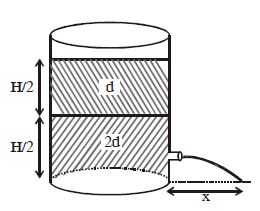
A container of large uniform cross-sectional area $A$ is resting on a horizontal surface holds two immiscible, non-viscous and incompressible liquids of densities $d$ and $2d$ each of height $\frac{H}{2}$ as shown. The lower density of liquid is open to atmosphere. A small hole is made on the wall of container at height $h\left( {h < \frac{H}{2}} \right)$. The initial speed of efflux of the liquid at the hole is
One solid sphere $A$ and another hollow sphere $B$ are of same mass and same outer radius. Their moments of inertia about their diameters are respectively, $I_A$ and $I_B$ such that:
A particle is moving in a circular path. The acceleration and momentum of the particle at a certain moment are $\vec a = (4\hat i + 3\hat j)\ m/s^2$ and $\vec p = (8\hat i - 6\hat j)\ kg-m/s$ . The motion of the particle is
A person standing on the floor of an elevator drops a coin. The coin reaches the floor of the elevator in a time $\mathrm{t}_1$ if the elevator is stationary and in time $\mathrm{t}_2$ if it is moving uniformly. Then:
 
A tachometer is a device to measure
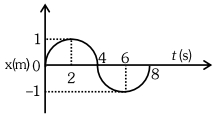
The $x-t$ graph of a particle performing simple harmonic motion is shown in the figure. The acceleration of the particle at $t=2 s$ is :