A stationary tuning fork is in resonance with an air column in a pipe. If the tuning fork is moved with a speed of $2 ms ^{-1}$ in front of the open end of the pipe and parallel to it, the length of the pipe should be changed for the resonance to occur with the moving tuning fork. If the speed of sound in air is $320 ms ^{-1}$, the smallest value of the percentage change required in the length of the pipe is. . . . . .
IIT 2020, Medium
Download our app for free and get started
$f \propto \frac{1}{\ell_1} \Rightarrow f =\frac{ k }{\ell_1}$ $. . . . . . (1)$
$\left(\ell_1 \Rightarrow \text { initial length of pipe }\right)$
$\left(\frac{ V }{ V - V _{ T }}\right) f =\frac{ k }{\ell_2}\left\{ V _{ T }\right.$ Speed of tuning fork, $\ell_2 \rightarrow$ new length of pipe $\}$
$\text { (1) } \div(2)$
$\frac{ V - V _{ T }}{ V }=\frac{\ell_2}{\ell_1}$
$\frac{\ell_2}{\ell_1}-1=\frac{ V - V _{ T }}{ V }-1$
$\frac{\ell_2-\ell_1}{\ell_1}=\frac{- V _{ T }}{ V }$
$\frac{\ell_2-\ell_1}{\ell_1} \times 100=\frac{-2}{320} \times 100=-0.625$
Therefore smallest value of percentage change required in the length of pipe is $0.625$

Download our appand get started for free
Experience the future of education. Simply download our apps or reach out to us for more information. Let's shape the future of learning together!No signup needed.*
Similar Questions
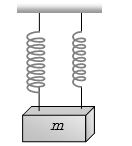
- 1A mass $m$ is suspended separately by two different springs of spring constant $K_1$ and $K_2$ gives the time-period ${t_1}$ and ${t_2}$ respectively. If same mass $m$ is connected by both springs as shown in figure then time-period $t$ is given by the relationView Solution
- 2Column $I$ gives a list of possible set of parameters measured in some experiments. The variations of the parameters in the form of graphs are shown in Column $II$. Match the set of parameters given in Column $I$ with the graph given in Column $II$. Indicate your answer by darkening the appropriate bubbles of the $4 \times 4$ matrix given in the $ORS$.View Solution
Column $I$ Column $II$ $(A)$ Potential energy of a simple pendulum (y axis) as a function of displacement ( $\mathrm{x}$ axis) $Image$ $(B)$ Displacement (y axis) as a function of time (x axis) for a one dimensional motion at zero or constant acceleration when the body is moving along the positive $\mathrm{x}$-direction $Image$ $(C)$ Range of a projectile (y axis) as a function of its velocity ( $\mathrm{x}$ axis) when projected at a fixed angle $Image$ $(D)$ The square of the time period (y axis) of a simple pendulum as a function of its length ( $\mathrm{x}$ axis) $Image$ 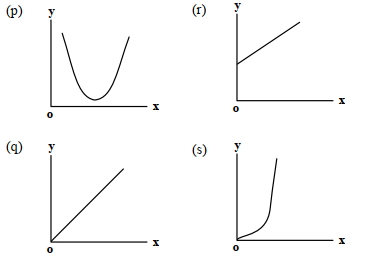
- 3A particle executes simple harmonic oscillation with an amplitude $a.$ The period of oscillation is $T.$ The minimum time taken by the particle to travel half of the amplitude from the equilibrium position isView Solution
- 4The time period of a simple pendulum of length $L$ as measured in an elevator descending with acceleration $\frac{g}{3}$ isView Solution
- 5A horizontal platform with an object placed on it is executing $S.H.M$. in the vertical direction. The amplitude of oscillation is $3.92 \times {10^{ - 3}}m$. What must be the least period of these oscillations, so that the object is not detached from the platformView Solution
- 6A small mass executes linear $SHM$ about $O$ with amplitude $a$ and period $T.$ Its displacement from $O$ at time $T/8$ after passing through $O$ is :View Solution
- 7A particle of mass $m$ is located in a one dimensional potential field where potential energy is given by : $V(x) = A(1 -cos\, px)$ ,View Solution
where $A$ and $p$ are constant.
The period of small oscillations of the particle is
- 8Two particles P and Q describe S.H.M. of same amplitude $a$, same frequency $f$ along the same straight line. The maximum distance between the two particles is a $\sqrt{2}$.The initial phase difference between the particle is -View Solution
- 9An object of mass $0.2\, kg$ executes simple harmonic along $X-$ axis with frequency of $\frac{{25}}{\pi }Hz$. At the position $x = 0.04m$, the object has kinetic energy of $0.5 \,J$ and potential energy of $0.4\, J$ amplitude of oscillation in meter is equal toView Solution
- 10A mass at the end of a spring executes harmonic motion about an equilibrium position with an amplitude $A.$ Its speed as it passes through the equilibrium position is $V.$ If extended $2A$ and released, the speed of the mass passing through the equilibrium position will beView Solution