Question
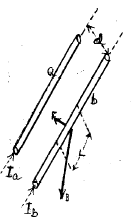
A steady current $(I_1)$ flows through a long straight wire. Another wire carrying steady current $(I_2)$ in the same direction is kept close and parallel to the first wire. Show with the help of a diagram how the magnetic field due to the current $I_1$ exerts a magnetic force on the second wire. Write the expression for this force.
Answer


$\text{F}_{12} = \text{I}_{2}\text{IB}_{1}$
$\text{F}_{12} = \frac{\mu_{o}\text{I}_{1}\text{I}_{2}}{2\pi\text{d}}\text{l}$.

Need a full question paper?

Generate a complete, print-ready paper with questions like this in minutes — across 16+ boards, with answer keys.

Start Generating Free

Similar questions

What happens to the energy of light waves in interference?
How can a bundle of optical fibers be used? Explain.
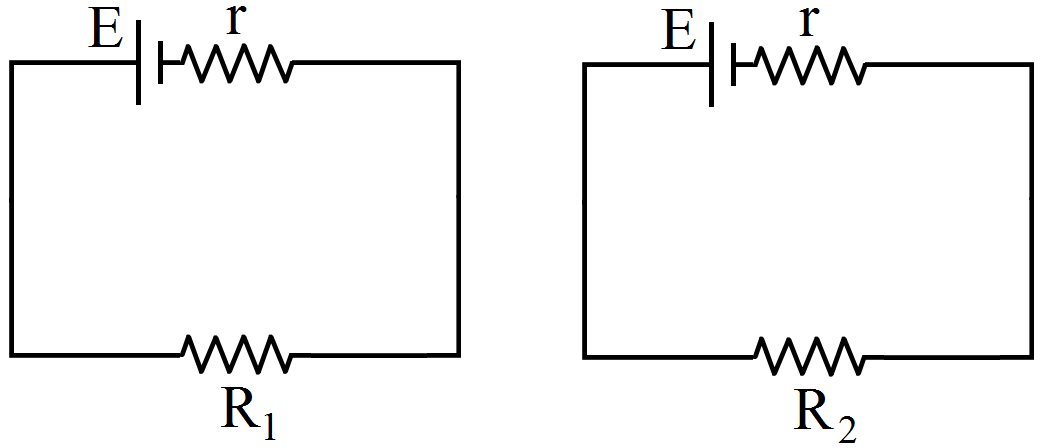
Two unequal resistances $R_1$ and $R_2$ are connected across two identical batteries of emf $\varepsilon$ and internal resistance $r.$ Can the thermal energies developed in $R_1$ and $R_{2}$ be equal in a given time. If yes, what will be the condition?
(a) When monochromatic light is incident on a surface separating two media, the reflected and refracted light both have the same frequency as the incident frequency. Explain why?
(b) When light travels from a rarer to a denser medium, the speed decreases. Does the reduction in speed imply a reduction in the energy carried by the light wave?
(c) In the wave picture of light, intensity of light is determined by the square of the amplitude of the wave. What determines the intensity of light in the photon picture of light.
Explain how current is formed in conductors.
A magnetic field of $100 G (1 G = 10^{–4} T)$ is required which is uniform in a region of linear dimension about $10 \ cm$ and area of cross$-$section about $10^{–3} m^2$ . The maximum current$-$carrying capacity of a given coil of wire is $15 A$ and the number of turns per unit length that can be wound round a core is at most $1000$ turns $m^{–1}.$ Suggest some appropriate design particulars of a solenoid for the required purpose. Assume the core is not ferromagnetic.
Two point electric charges of unknown magnitude and sign are placed at some distance ‘d’ apart. The electric field intensity is zero at a point, not between the charges but on the line joining them.
Write two essential conditions for this to happen.
The charge on a proton is $+1.6 \times 10^{-19}C$ and that on an electron is $-1.6 \times 10^{-19}C.$ Does it mean that the electron has a charge $3.2 \times 10^{-19}C$ less than the charge of a proton?
The equation of an A.C. is $I = 20 sin 200 \pi t$. Find out the frequency, peak value and rms value of the current.
A resistance is connected to an $AC$ source. If a capacitor is included in the series circuit, will the average power absorbed by the resistance increase or decrease? If an inductor of small inductance is also included in the series circuit, will the average power absorbed increase or decrease further?