MCQ
A steel rod $100\, cm$ long is damped at into middle. The fundamental frequency of longitudinal vibrations of the rod are given to be $2.53\, kHz$. What is the speed of sound in sound is steel ? (in $km/s$)
  • A
    $6.2$
  • $5.06$
  • C
    $7.23$
  • D
    $7.45$

Answer

Correct option: B.
$5.06$
b
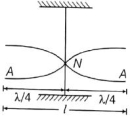
In fundamental mode, $l=2\left(\frac{\lambda}{4}\right)=\frac{\lambda}{2}$

$\Rightarrow \lambda=2 l \ldots(i)$

Given, $l=100 cm , v=2.53 kHz =2.53 \times 10^{3} Hz$

We know that,

$v=v \lambda$

$=v \times 2 l$ [from equation $(i)]$

$=2.53 \times 10^{3} \times 2 \times 100 \times 10^{-2}$

$=5.06 \times 10^{3} m / s$

$=5.06 km / s$
Need a full question paper?

Generate a complete, print-ready paper with questions like this in minutes — across 16+ boards, with answer keys.
Start Generating Free

Similar questions

An observer moves with a constant speed along the line joining two stationary objects. He will observe that the two objects
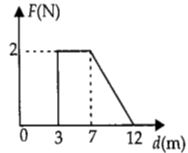
Force $F$ on a particle moving in a straight line varies with distance $d$ as shown in figure.The work done on the particle during its displacement of $12\, m$ is ................. $\mathrm{J}$
In which of the following cases the centre of mass of a rod is certainly not at its centre?
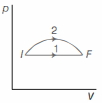
An ideal gas undergoes change in its state from the initial state $I$ to the final state $F$ via two possible paths as shown below. Then,
A train moving towards a hill at a speed of $72\ km/hr$ sounds a whistle of frequency $500\ Hz$ . A wind is blowing from the hill at a speed of $36\ km/hr$ . If the speed of sound in air is $340\ m/s$ , the frequency heard by a man on the hill (nearly) is ... $Hz$
A rocket is fired vertically up from the ground with a resultant acceleration of $10\,m / s ^2$. The fuel is finished in $1 min$ and it continues to move up $\left(g=10\,m / s ^2\right)$
A planet of radius $R_{p}$ is revolving around a star of radius $R^{*}$, which is at temperature $T^{*}$. The distance between the star and the planet is $d$. If the planet's temperature is $f T^{*}$, then $f$ is proportional to
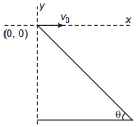
A man standing on a hill top projects a stone horizontally with speed $v_0$ as shown in figure. Taking the coordinates system as given in the figure. The coordinates of the point, where the stone will hit the hill surface are
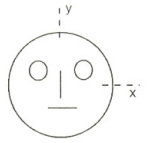
Look at the drawing given in the figure which has been drawn with ink of uniform line-thickness. The mass of ink used to draw each of the two inner circles, and each of the two line segments is $m$. The mass of the ink used to draw the outer circle is $6 \mathrm{~m}$. The coordinates of the centres of the different parts are: outer circle $(0,0)$, left inner circle $(-a, a)$, right inner circle $(a, a)$, vertical line $(0,0)$ and horizontal line $(0,-a)$. The $y$-coordinate of the centre of mass of the ink in this drawing is
Two blocks of masses $5 \,kg$ and $2 \,kg$ are connected by a spring of negilible mass and placed on a frictionless horizontal surface. An impulse gives a velocity of $7 \,m / s$ to the heavier block in the direction of the lighter block. The velocity of the centre of mass is ....... $m / s$