Question
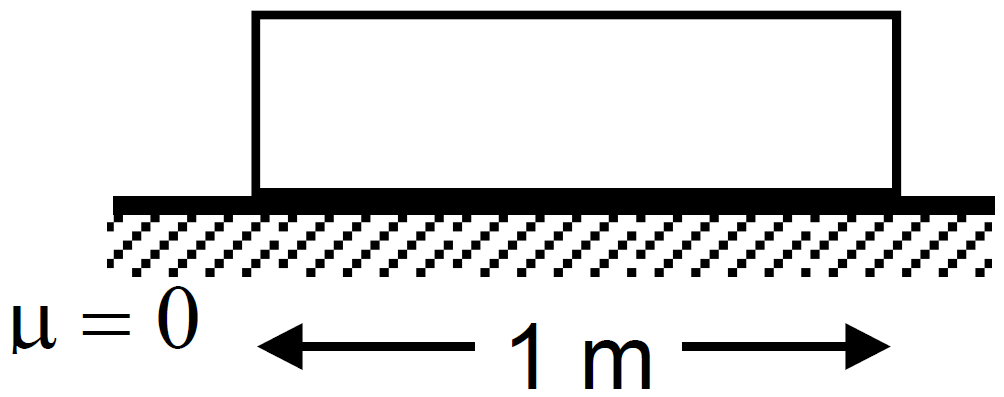
A steel rod of length 1 m rests on a smooth horizontal base. If it is heated from $0^{\circ} \mathrm{C}$ to $100^{\circ} \mathrm{C}$, what is the longitudinal strain developed?
Answer


$\Delta\text{L}=100^\circ\text{C}$
A longitudinal strain develops if and only if, there is an opposition to the expansion.
Since there is no opposition in this case, hence the longitudinal stain here = Zero.

Need a full question paper?

Generate a complete, print-ready paper with questions like this in minutes — across 16+ boards, with answer keys.
Start Generating Free

Similar questions

How can you find the mass of earth, starting from the law of gravitation?
A block of mass M is held against a rough vertical wall by pressing it with a finger. If the coefficient of friction between the block and the wall is $\mu$ and the acceleration due to gravity is g, calculate the minimum force required to be applied by the finger to hold the block against the wall?
Evaluate Rydberg constant by putting the values of the fundamental constants in its expression.
When a labourer cuts down a tree, he makes a cut on the side facing the direction in which he wants it to fall.Why?
What is called stream line flow?
The string of a tunning fork and a tuning fork are played simultaneously. At length of the wire is kept at 0.49 meter or 0.50 meter. 4 beats per second are heared. what is the frequency of tunning fork?
A soda water bottle is falling freely. Will the bubbles of gas rise in the water of the bottle?
A mass m is dropped in a tunnel along the diameter of earth from a height $h (< < R)$ above the surface of earth. Find the time period of motion, is the motion simple harmonic?
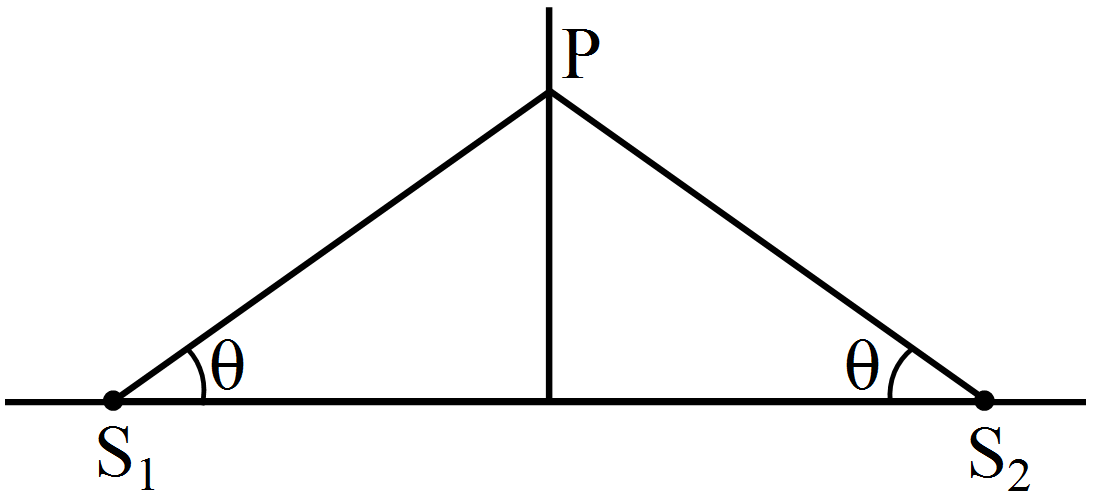
Two sources of sound $S_1$ and $S_2$ vibrate at same frequency and are in phase figure. The intensity of sound detected at a point $P$ as shown in the figure is $I _0$.
a. If 0 equals $45^{\circ}$, what will be the intensity of sound detected at this point if one of the sources is switched off?
b. What will be the answer of the previous part if $=60^{\circ}$ ?
A car is lifted by a hydraulic jack that consist of two pistons. The large piston is 1m in diameter and small piston is 10cm in diameter. If W is the weight of the car, how much smaller a force is needed on the small piston to lift the car?