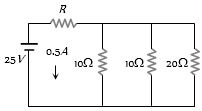
A steel wire has a resistance twice that of an aluminium wire. Both of them are connected with a constant voltage supply. More heat will be dissipated in
Easy


Download our appand get started for free
Experience the future of education. Simply download our apps or reach out to us for more information. Let's shape the future of learning together!No signup needed.*
Similar Questions
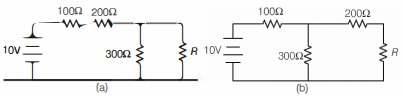
- 1A student was trying to construct the circuit shown in the figure below marked $(a)$, but ended up constructing the circuit marked $(b)$. Realising her mistake, she corrected the circuit, but to her surprise, the output voltage (across $R$ ) did not change. The value of resistance $R$ is ............ $\Omega$View Solution
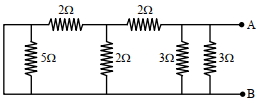
- 2The equivalent resistance of the given circuit between the terminals ${A}$ and ${B}$ is $....\Omega$View Solution
- 3View SolutionIn the following circuit composed of identical resistors, across which terminals would you connect a battery in order to dissipate energy in all resistors
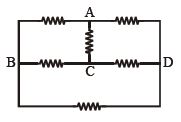
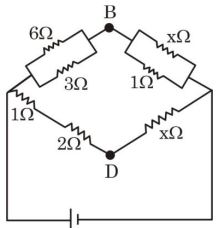
- 4If the potential difference between $B$ and $D$ is zero, the value of $x$ is $\frac{1}{n} \Omega$. The value of $n$ is .......View Solution
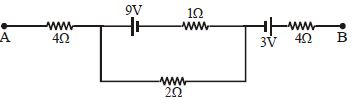
- 5In the circuit shown in figure, potential difference between points $A$ and $B$ is $16\, V$. The current passing through $2\,\Omega $ resistance will be ................. $\mathrm{A}$View Solution
- 6An electron revolves $6 × 10^{15}$ times/sec in circular loop. The current in the loop isView Solution
- 7For comparing the $e.m.f.$'s of two cells with a potentiometer, a standard cell is used to develop a potential gradient along the wires. Which of the following possibilities would make the experiment unsuccessfulView Solution
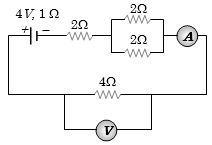
- 8What is the equivalent resistance of the circuit ............. $\Omega$View Solution
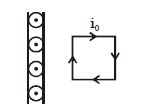
- 9Figure shows a cross-section of a large-section of an infinite metal sheet carrying an electric current along its surface. The current per unit length is $J$ . A current carrying square loop is placed nearby the metal sheet such that the plane of square is perpendicular to the plane of sheet thenView Solution
- 10View SolutionIn the circuit as shown in figure the