Question
A stone is dropped from a tower $98 $m high. With what speed should a second stone be thrown $1$ s later so that both hit the ground at the same time?

Answer

Height of tower $=98 m$
Acceleration due to gravity on stone $=9.8 ms^{-2}$.
Initial speed of ball $=0 ms^{-1}$.
Let initial speed of second stone is $v ms ^{-1}$.
We know from second equation of motion
$S = ut + 1/2 a Xt^2.$
$98 = 0 + 1/2 X9.8Xt^2.$
$t^2 = 20$
$t= 4.47 \sec.$
As second stone is thrown $1$ sec later so time taken by second body to cover distance of $98 m$ is $= 4.47 - 1 = 3.47sec.$
So again put t= 3.47 sec and S = 98 m in second equation of motion we get
$98 = vX3.47 + 1/2 X9.8X3.47X3.47.$
$98 = 3.47Xv + 59$
$3.47X v = 98 - 59$
$v= 39/3.47 = 11.23 ms^{-1}.$
Initial speed of second stone should be $11.23 ms^{-1}.$

Need a full question paper?

Generate a complete, print-ready paper with questions like this in minutes — across 16+ boards, with answer keys.
Start Generating Free

Similar questions

State and explain the law of inertia (or Newton's first law of motion).
Compare the time periods of a simple pendulum at places where $g =9.8 ms^{-2}$ and $4.36 ms^{-2}$ respectively.
(a) Define simple pendulum.
(b) State two factors which determine time period of a simple pendulum.
(c) Write an expression for the time period of a simple pendulum.
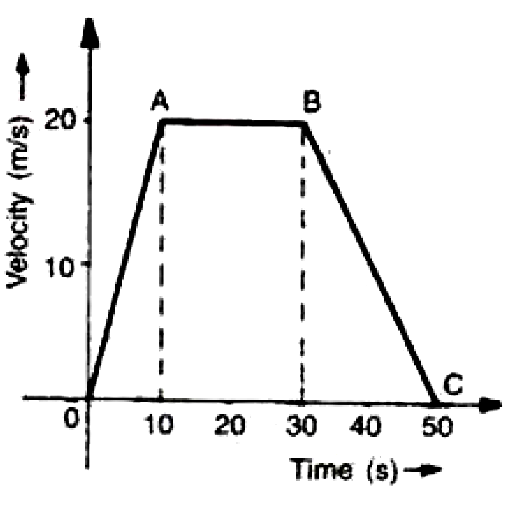
The graph shows how the velocity of a scooter varies with time in 50 s.
Work out: The distance traveled in 10 s, 20 s, and 50 s.
A body at rest is thrown downward from the top of tower. Draw a distance - time graph of its free fall under gravity during first 3 seconds. Show your table of values starting $t=$ 0 with an interval of 1 second, $\left( g =10 ms^{-2}\right)$.
(a) What should be the minimum size of a plane mirror, so that a person 182 cm high can see himself completely?
(b) A boy stands 4 m away from plane mirror. If the boy moves $1 / 2 m$ towards mirror, what is now the distance between the boy and his image? Give a reason for your answer.
 A solid weighs 32 gf in air and 28.8 gf in water. Find: (i) The volume of solid, (ii) R.D. of solid and (iii) The weight of solid in a liquid of density $0.9 g cm ^{-3}$.
A hollow cylinder of copper of length 25 cm and area of cross-section 15 cm , floats in water with $3 / 5$ of its length inside water. Calculate:
(1) apparent density of hollow copper cylinder.
(2) wt. of cylinder.
(3) extra force required to completely submerge it in water.
Define : magnetic field, magnetic meridian, geographical meridian, declination and magnetic equator.
The pitch of a screw gauge is 1 mm and the circular scale has 100 divisions. In measurement of the diameter of a wire, the main scale reads 2 mm and 45th mark on the circular scale coincides with the base line. Find
(i) The least count and
(ii) The diameter of the wire.