MCQ
A stone is projected from the ground with velocity $25\,m/s$. Two seconds later, it just clears a wall $5 \,m$ high. The angle of projection of the stone is ........ $^o$ $(g = 10m/{\sec ^2})$
  • ${30}$
  • B
    ${45}$
  • C
    ${50.2}$
  • D
    ${60}$

Answer

Correct option: A.
${30}$
a
(a) For vertical upward motion $h = ut - \frac{1}{2}g{t^2}$

$5 = (25\sin \theta ) \times 2 - \frac{1}{2} \times 10 \times {(2)^2}$

$⇒$ $25 = 50 \sin \theta $ 

$⇒$ $\sin \theta = \frac{1}{2}$

$⇒$ $\theta = 30^\circ $

Need a full question paper?

Generate a complete, print-ready paper with questions like this in minutes — across 16+ boards, with answer keys.
Start Generating Free

Similar questions

A weightless spring of length $60\, cm$ and force constant $200\, N/m$ is kept straight and unstretched on a smooth horizontal table and its ends are rigidly fixed. A mass of $0.25\, kg$ is attached at the middle of the spring and is slightly displaced along the length. The time period of the oscillation of the mass is
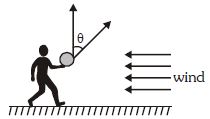
A body throws a ball upwards with velocity $v_0 = 20\, m/s$ . The wind imparts a horizontal acceleration of $4\, m/s^2$ to the ball. The angle $\theta $ from vertical at which the ball must be thrown so that the ball returns to the boy's hand is $(g = 10\, m/s^2)$
A body of mass $2$ kg is moving on the ground comes to rest after some time. The coefficient of kinetic friction between the body and the ground is $0.2$. The retardation in the body is ...... $m/s^2$ 
Two waves are represented by

$y_1=5 \sin 2 \pi(75 t-0.25 x)$

$y_2=10 \sin 2 \pi(150 t-0.50 x)$

The intensity ratio $\frac{I_1}{I_2}$ of the two waves is
If $g \propto \frac{1}{{{R^3}}}$ (instead of $\frac{1}{{{R^2}}}),$ then the relation between time period of a satellite near earth's surface and radius $R$ will be
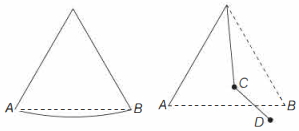
A simple pendulum oscillates freely between points $A$ and $B$. We now put a peg (nail) at the point $C$ as shown in above figure. As the pendulum moves from $A$ to the right, the string will bend at $C$ and the pendulum will go to its extreme point $D$. Ignoring friction, the point $D$
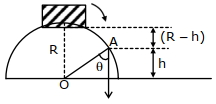
A small block slides down from the top of hemisphere of radius $R=3\, {m}$ as shown in the figure. The height $'h'$ at which the block will lose contact with the surface of the sphere is $.............  \;\;m$. (Assume there is no friction between the block and the hemisphere)
During inelastic collision between two bodies, which of the following quantities always remain conserved
A metal rod $\mathrm{AB}$ of length $10 x$ has its one end $\mathrm{A}$ in ice at $0^{\circ} \mathrm{C}$ and the other end $\mathrm{B}$ in water at $100^{\circ} \mathrm{C}$. If a point $\mathrm{P}$ on the rod is maintained at $400^{\circ} \mathrm{C}$, then it is found that equal amounts of water and ice evaporate and melt per unit time. The latent heat of evaporation of water is $540 \ \mathrm{cal} / \mathrm{g}$ and latent heat of melting of ice is $80 \ \mathrm{cal} / \mathrm{g}$. If the point $\mathrm{P}$ is at a distance of $\lambda x$ from the ice end $\mathrm{A}$, find the value of $\lambda$.

[Neglect any heat loss to the surrounding.|

There is a simple pendulum hanging from the ceiling of a lift. When the lift is stand still, the time period of the pendulum is $T$. If the resultant acceleration becomes $g/4,$ then the new time period of the pendulum is