MCQ
A stone is projected in air. Its time of flight is $3\,s$ and range is $150\,m$ Maximum height reached by the stone is $......\,m$ $\left(g=10\,ms ^{-2}\right)$
  • A
    $37.5$
  • B
    $22.5$
  • C
    $90$
  • $11.25$

Answer

Correct option: D.
$11.25$
d
(d)

$T=\frac{2 u_y}{g}=3$

$\therefore \quad u_y=15\,m / s$

Now,

$H=\frac{u_y^2}{2 g}=\frac{(15)^2}{20}=11.25\,m$

Need a full question paper?

Generate a complete, print-ready paper with questions like this in minutes — across 16+ boards, with answer keys.

Start Generating Free

Similar questions

Two wires of the same material have lengths in the ratio 1 : 2 and their radii are in the ratio $1:\sqrt 2 $. If they are stretched by applying equal forces, the increase in their lengths will be in the ratio
Which one of the following plots represents the variation of gravitational field on a particle with distance $r$ due to a thin spherical sheel of radius $R$ ? ($r$ is measured from the centre of the spherical shell )
A piece of wood is floating in water kept in a bottle. The bottle is connected to an air pump. Neglect the compressibility of water. When more air is pushed into the bottle from the pump, the piece of wood will float with.
According to first law of thermodynamics:
A long cylindrical vessel is half filled with a liquid. When the vessel is rotated about its own vertical axis, the liquid rises up near the wall. If the radius of vessel is $5\,cm$ and its rotational speed is $2$ rotations per second, then the difference in the heights between the centre and the sides, in $cm,$ will be
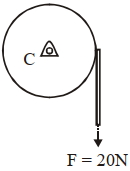
Consider a $20\, kg$ uniform circular disk of radius $0.2\, m$. It is pin supported at its center and is at rest initially. The disk is acted upon by a constant force $F =20\, N$ through a massless string wrapped around its periphery as shown in the figure.

Suppose the disk makes n number of revolutions to attain an angular speed of $50\, rad s ^{-1} .$ The value of $n$, to the nearest integer, is.......... [Given : In one complete revolution, the disk rotates by $6.28\, rad$ ]
The spectrum from a black body radiation is a
According to atomic hypothesis:
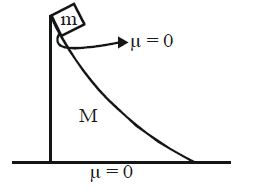
A smooth rightangled wedge of mass $M$ is kept on a smooth horizontal surface as shown. A mass $m$ is released from top of wedge when $m$ reaches ground its speed is $V$. Work done by normal contact force on $m$, while it comes down to ground is :-
A force of $F=(5 y+20) \hat{j} \,N$ acts on a particle. The work done by this force when the particle is moved from $y=0 \,m$ to $y=10 \,{m}$ is $...\,{J}.$