MCQ
A stone of mass $0.3\,kg$ attached to a $1.5\,m$ long string is whirled around in a horizontal circle at a speed of $6\,m s ^{-1}$. The tension in the string is $............\,N$
  • A
    $10$
  • B
    $20$
  • $7.2$
  • D
    $30$

Answer

Correct option: C.
$7.2$
c
(c)

The force of tension in the string provides required centripetal force to keep the stone in circular motion.

$\therefore T=\frac{m v^2}{R}=\frac{0.3 \times(6)^2}{1.5}=7.2\,N$

Need a full question paper?

Generate a complete, print-ready paper with questions like this in minutes — across 16+ boards, with answer keys.
Start Generating Free

Similar questions

Who discovers famous theory of relativity?
A ball of mass $0.5 \; kg$ is dropped from the height of $10 \; m$. The height, at which the magnitude of velocity becomes equal to the magnitude of acceleration due to gravity, is $\dots \; m$. (Use $g =10 \; m / s ^{2}$).
A container is divided into two equal parts $I$ and $II$ by a partition with a small hole of diameter $d$. The two partitions are filled with same ideal gas, but held at temperatures $T_{ I }=150 \,K$ and $T_{ II }=300 \,K$ by connecting to heat reservoirs. Let $\lambda_{1}$ and $\lambda_{1 I}$ be the mean free paths of the gas particles in the two parts, such that $d >> \lambda_{ I }$ and $d >> \lambda_{ II }$. Then, the $\lambda_{ I } / \lambda_{ II }$ is close to
The length of a simple pendulum is increased by $2\%$. Its time period will
If an ideal gas is compressed isothermally. Which of the following statements is true?
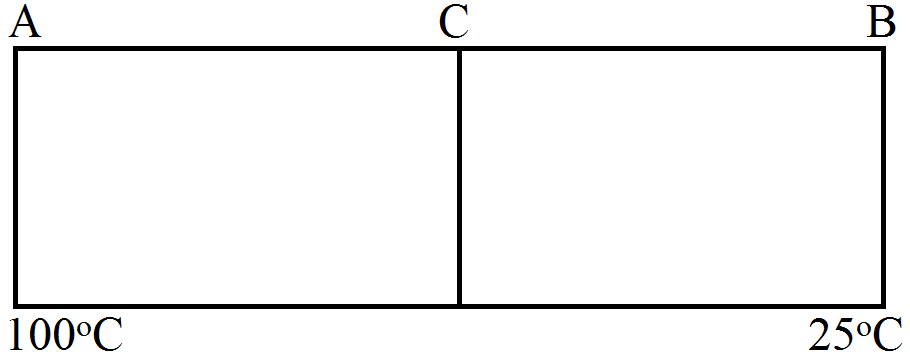
Two identical rods $AC$ and $CB$ made of two different metals having thermal conductivities in the ratio $2 : 3$ are kept in contact with each other at the end $C$ as shown in Fig. $A$ is at $100^\circ C$ and $B$ is at $25^\circ C.$ Then the junction $C$ is at:
Two particles are moving along two long straight lines, in the same plane, with the same speed $= 20 \,\,cm/s$. The angle between the two lines is $60^o$, and their intersection point is $O$. At a certain moment, the two particles are located at distances $3\,m$ and $4\,m$ from $O$, and are moving towards $O$. Subsequently, the shortest distance between them will be
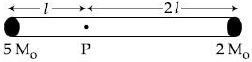
A rigid massless road of length $3l$ has tow masses attached at each end as shown in the figure. The rod is pivoted at point $P$ on the horizontal axis (see figure). When released from initial horizontal position, its instantaneous angular acceleration will be
A particle is acted by a constant power. Then, which of the following physical quantity remains constant?
The average energy in one time period in simple harmonic motion is: