MCQ
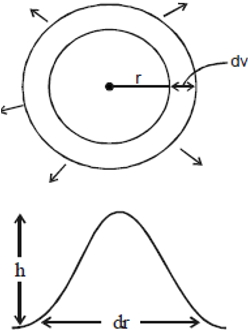
A stone thrown into still water, creates a circular wave pattern moving radially outwards. If $r$ is the distance measured from the centre of the pattern. the amplitude of the wave aries as
  • $r^{-1/2}$
  • B
    $r^{-1}$
  • C
    $r^{-2}$
  • D
    $r^{-3/2}$

Answer

Correct option: A.
$r^{-1/2}$
a
Energy of crest $(\mathrm{P.E})=(2 \pi \mathrm{r} . \mathrm{dr} \times \mathrm{h} \times \rho) \times \mathrm{g} \times \mathrm{h}$

Now, as crest spread, this energy $E$ remains constant. So,

$2 \pi r d r h^{2} \rho g=E$

$\Rightarrow \mathrm{h}=\sqrt{\frac{\mathrm{E}}{2 \pi \mathrm{rdr} \rho \mathrm{g}}}$ or $\mathrm{h} \propto \mathrm{r}^{-1 / 2}$
Need a full question paper?

Generate a complete, print-ready paper with questions like this in minutes — across 16+ boards, with answer keys.
Start Generating Free

Similar questions

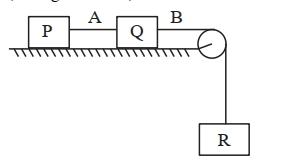
Each of three blocks $P$, $Q$ and $R$ shown in figure has a mass of $3 \mathrm{~kg}$. Each of the wire $A$ and $B$ has cross-sectional area $0.005 \mathrm{~cm}^2$ and Young's modulus $2 \times 10^{11} \mathrm{~N} \mathrm{~m}^{-2}$. Neglecting friction, the longitudinal strain on wire $B$ is____________ $\times 10^{-4}$. $\left(\right.$ Take $\mathrm{g}=10 \mathrm{~m} / \mathrm{s}^2$ )
A person with his hand in his pocket is skating on ice at the rate of $10 m / s$ and describes a circle of radius $50 m$. What is his inclination to vertical: $\left( g =10 m / sec ^2\right)$
Which of the following velocity-time graphs represent uniform motion
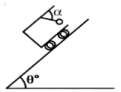
A trolley is falling freely on inclined plane as shown in the figure. The angle of string of pendulum with the ceiling of trolley is $(\alpha)$ equal to ..........
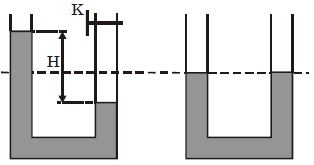
A $U$ -tube of small and uniform cross section contains water of total length $4H$. The height difference between the water columns on the left and on the right is $H$ when the valve $K$ is closed. The valve is suddenly open, and water is flowing from left to right. Ignore friction. The speed of water when the heights of the left and the right water columns are the same, is :-
A jet of liquid of cross-sectional area $'a'$ strikes a wall making angle $\theta $ with wall. The water strikes with the wall with velocity $v$ and rebounds elastically. If density of liquid be $\rho $, the normal force on the wall is
A particle moves on a straight line with a uniform velocity. Its angular momentum:
The potential energy for a force field $\overrightarrow{ F }$ is given by $U(x, y)=\cos (x+y)$. The force acting on a particle at position given by coordinates $(0, \pi / 4)$ is $-$
A solid sphere of radius $r$ made of a soft material of bulk modulus $K$ is surrounded by a liquid in a cylindrical container. A massless piston of area $a$ floats on the surface of the liquid, covering entire crosssection of cylindrical container. When a mass $m$ is placed on the surface of the piston to compress the liquid, the fractional decrement in the radius of the sphere, $\left( {\frac{{dr}}{r}} \right)$ is 
A liquid drop placed on a horizontal plane has a near spherical shape (slightly flattened due to gravity). Let $R$ be the radius of its largest horizontal section. A small disturbance causes the drop to vibrate with frequency $v$ about its equilibrium shape. By dimensional analysis, the ratio $\frac{v}{\sqrt{\sigma / \rho R^3}}$ can be (Here, $\sigma$ is surface tension, $\rho$ is density, $g$ is acceleration due to gravity and $k$ is an arbitrary dimensionless constant)