MCQ
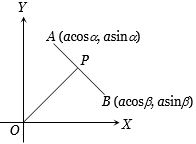
A straight line through origin bisect the line passing through the given points $(a\cos \alpha ,a\sin \alpha )$ and $(a\cos \beta ,a\sin \beta )$, then the lines are
  • Perpendicular
  • B
    Parallel
  • C
    Angle between them is $\frac{\pi }{4}$
  • D
    None of these

Answer

Correct option: A.
Perpendicular
a
(a) Mid point of $(a\,\cos \alpha ,a\sin \alpha )$ and $(a\cos \beta ,a\sin \beta )$ is $P\,\left( {\frac{{a(\cos \alpha + \cos \beta )}}{2},\frac{{a(\sin \alpha + \sin \beta )}}{2}} \right)$

Slope of line $AB$ is $\frac{{a\sin \beta - a\sin \alpha }}{{a\cos \beta - a\cos \alpha }}$$ = \frac{{\sin \beta - \sin \alpha }}{{\cos \beta - \cos \alpha }} = {m_1}$

and slope of $OP$is $\frac{{\sin \alpha + \sin \beta }}{{\cos \alpha + \cos \beta }} = {m_2}$

.Now ${m_1} \times {m_2} = \frac{{{{\sin }^2}\beta - {{\sin }^2}\alpha }}{{{{\cos }^2}\beta - {{\cos }^2}\alpha }} = - 1$

Hence the lines are perpendicular.

Need a full question paper?

Generate a complete, print-ready paper with questions like this in minutes — across 16+ boards, with answer keys.

Start Generating Free

Similar questions

A function $f$ is defined as follows,

$f(x) =$ $\left\{ {\begin{array}{*{20}{c}}  {\sin \,x}&{if\,\,\,x\,\, \leqslant \,\,c} \\   {ax\, + \,b}&{if\,\,\,x\,\, > \,\,c} \end{array}} \right.$ where $c$ is a known quantity.

If $f$ is derivable at $x = c$ , then the values of $'a'$ $and$ $'b’$ are _____ $and$______ respectively

If $f(x) = \left\{ \begin{array}{l}x - 1,\,\,\,x < 0\\\,\,\,\,\,\,\frac{1}{4},\,\,x = 0\\\,\,\,\,\,\,\,{x^2},\,\,x > 0\end{array} \right.$, then
If ${\tan ^{ - 1}}x + 2{\cot ^{ - 1}}x = \frac{{2\pi }}{3},$ then $x =$
The matrix $\left( {\begin{array}{*{20}{c}}1&a&2\\1&2&5\\2&1&1\end{array}} \right)$ is not invertible, if  $‘a’ $ has the value
For $\alpha, \beta, \gamma \neq 0$. If $\sin ^{-1} \alpha+\sin ^{-1} \beta+\sin ^{-1} \gamma=\pi$ and $(\alpha+\beta+\gamma)(\alpha-\gamma+\beta)=3 \alpha \beta$, then $\gamma$ equal to
The vertices of a triangle are $[a{t_1}{t_2},\,a({t_1} + {t_2})],\,$ $[a{t_2}{t_3},\,a({t_2} + {t_3})]$, $[a{t_3}{t_1},\,a({t_3} + {t_1})]$, then the coordinates of its orthocentre are
If $a,b,c$ are respectively the ${p^{th}},{q^{th}}{r^{th}}$terms of an $A.P.,$ the $\left| {\,\begin{array}{*{20}{c}}a&p&1\\b&q&1\\c&r&1\end{array}\,} \right| = $
If $x\in (0,\frac{\pi}{4})$ then the expression $ \frac{cos x}{sin^2 x(cos x-sin x)}$ can not take the value
Let $f : R \rightarrow R$ and $g : R \rightarrow R$ be defined as $f(x)=\left\{\begin{array}{lll}\log _e x & , & x>0 \\ e^{-x} & , & x \leq 0\end{array}\right.$ and $g(x)=\left\{\begin{array}{ccc}x & , & x \geq 0 \\ e^x & , & x<0\end{array}\right.$. Then, gof $: R \rightarrow R$ is :
The equations of the tangents to the circle ${x^2} + {y^2} = 13$ at the points whose abscissa is $2$, are