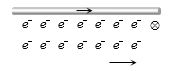
A stream of electrons is projected horizontally to the right. A straight conductor carrying a current is supported parallel to electron stream and above it. If the current in the conductor is from left to right then what will be the effect on electron stream
Easy


Download our appand get started for free
Experience the future of education. Simply download our apps or reach out to us for more information. Let's shape the future of learning together!No signup needed.*
Similar Questions
- 1View SolutionEnergy in a current carrying coil is stored in the form of
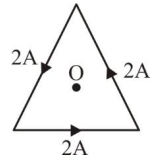
- 2As shown in the figure, a current of $2\,A$ flowing in an equilateral triangle of side $4 \sqrt{3}\,cm$. The magnetic field at the centroid $O$ of the triangle is:View Solution
(Neglect the effect of earth's magnetic field.)
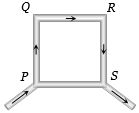
- 3$PQRS$ is a square loop made of uniform conducting wire the current enters the loop at $P$ and leaves at $S$. Then the magnetic field will beView Solution
- 4A proton and an $\alpha -$ particle (with their masses in the ratio of $1 : 4$ and charges in the ratio of $1:2$ are accelerated from rest through a potential difference $V$. If a uniform magnetic field $(B)$ is set up perpendicular to their velocities, the ratio of the radii $r_p : r_{\alpha }$ of the circular paths described by them will beView Solution
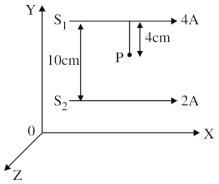
- 5Two long parallel conductors $S_{1}$ and $S_{2}$ are separated by a distance $10 \,cm$ and carrying currents of $4\, A$ and $2 \,A$ respectively. The conductors are placed along $x$-axis in $X - Y$ plane. There is a point $P$ located between the conductors (as shown in figure).View Solution
A charge particle of $3 \pi$ coulomb is passing through the point $P$ with velocity
$\overrightarrow{ v }=(2 \hat{ i }+3 \hat{ j }) \,m / s$; where $\hat{i}$ and $\hat{j} \quad$ represents unit vector along $x$ and $y$ axis respectively.
The force acting on the charge particle is $4 \pi \times 10^{-5}(-x \hat{i}+2 \hat{j}) \,N$. The value of $x$ is
- 6View SolutionIf two streams of protons move parallel to each other in the same direction, then they
- 7A particle of charge $16\times10^{-16}\, C$ moving with velocity $10\, ms^{-1}$ along $x-$ axis enters a region where magnetic field of induction $\vec B$ is along the $y-$ axis and an electric field of magnitude $10^4\, Vm^{-1}$ is along the negative $z-$ axis. If the charged particle continues moving along $x-$ axis, the magnitude of $\vec B$ isView Solution
- 8A thin circular disk of radius $R$ is uniformly charged with density $\sigma>0$ per unit area. The disk rotates about its axis with a uniform angular speed $\omega$. The magnetic moment of die disk isView Solution
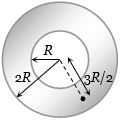
- 9Figure shows the cross-sectional view of the hollow cylindrical conductor with inner radius '$R$' and outer radius '$2R$', cylinder carrying uniformly distributed current along it's axis. The magnetic induction at point '$P$' at a distance $\frac{{3R}}{2}$ from the axis of the cylinder will beView Solution
- 10A $36 \,\Omega$ galvanometer is shunted by resistance of $4\,\Omega$. The percentage of the total current, which passes through the galvanometer isView Solution