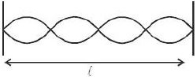
A string is clamed at both the ends and it is vibrating in its $4^{th}$ harmonic. The equation of the stationary wave is $Y =0.3\,sin\,(0.157\,x) \,cos\,(200\pi t)$. The length of the string is ..... $m$ (all quantities are in $SI$ units)
A$60$
B$80$
C$40$
D$20$
JEE MAIN 2019, Medium
Download our app for free and get started
B$80$
b $4^{\text {th }}$ harmonic
$4 \frac{\lambda}{2}=\ell \quad ; 2 \lambda=\ell$
From equation $\frac{2 \pi}{\lambda}=0.157$
$\lambda=40 ; \quad \ell=2 \lambda=80 \mathrm{m}$
Download our app
and get started for free
Experience the future of education. Simply download our apps or reach out to us for more information. Let's shape the future of learning together!No signup needed.*
The displacement of a particle is given by $y = 5 \times {10^{ - 4}}\sin (100t - 50x)$, where $x$ is in meter and $t$ in sec, find out the velocity of the wave .... $m/sec$
The tension of a stretched string is increased by $69\%$. In order to keep its frequency of vibration constant, its length must be increased by .... $\%$
A train moves towards a stationary observer with speed $34 m/s$. The train sounds a whistle and its frequency registered by the observer is ${f_1}$. If the train’s speed is reduced to $17\, m/s$, the frequency registered is ${f_2}$. If the speed of sound is 340 m/s then the ratio ${f_1}/{f_2}$ is
A pipe of length $1.5\ m$ closed at one end is filled with gas and resonates in its fundamental mode with a tuning fork. Another open organ pipe of same dimensions filled with air resonates in its fundamental mode with same tuning fork. If experiment is performed at $30\,^oC$ (speed of sound in air is $360\ m/sec$ at $30\,^oC$), the speed of sound at $0\,^oC$ in gas is ...... $m/sec$ (Neglect end correction)
Two loudspeakers $L_1$ and $L_2$ driven by a common oscillator and amplifier, are arranged as shown. The frequency of the oscillator is gradually increased from zero and the detector at $D$ records a series of maxima and minima. If the speed of sound is $330\,ms^{-1}$ then the frequency at which the first maximum is observed is .... $Hz$
The ends of stretched wire of length $L$ are fixed at $x\, = 0$ and $x \,= L$. In one experiment, the displacement of the wire is ${y_1} = A\sin\, \left( {\pi x/L} \right)\sin \,\omega t$ and energy is $E_1$. and in another experiment its displacement is ${y_2} = A\sin \,\left( {2\pi x/L} \right)\sin 2\omega t$ and energy is $E_2$, Then
Three waves of equal frequency having amplitudes $10\, \mu m, 4\, \mu m$ and $7\, \mu m$ arrive at a given point with successive phase difference of $\pi/2$. The amplitude of the resulting wave in $\mu m$ is given by
The frequency of a sonometer wire is $f$, but when the weights producing the tensions are completely immersed in water the frequency becomes $f/2$ and on immersing the weights in a certain liquid the frequency becomes $f/3$. The specific gravity of the liquid is:
An engine moving away from a vertical cliff blows a horn at a frequency $f$. Its speed is $0.5 \%$ of the speed of sound in air. The frequency of the reflected sound received at the engine is ............ $f$