MCQ
A string is stretched between two fixed points separated by $75\,cm$ . It is observed to have resonant frequencies of $420\,Hz$ and $315\,Hz$ . There are no other resonant frequencies between these two. Then, the lowest resonant frequency for this string is  ..... $Hz$
  • A
    $10.5$
  • $105$
  • C
    $1.05$
  • D
    $1050$

Answer

Correct option: B.
$105$
b
$\frac{\mathrm{n}}{2 l} \mathrm{v}=315 \quad$ and $\quad \frac{(\mathrm{n}+1) \mathrm{v}}{2 l}=420$

Solving $, \frac{\mathrm{v}}{2 l}=105 \mathrm{\,Hz}$

Need a full question paper?

Generate a complete, print-ready paper with questions like this in minutes — across 16+ boards, with answer keys.

Start Generating Free

Similar questions

A person sitting in a moving train with his face towards the engine, throws a coin vertically upwards. The coin falls ahead of person. The train:
A long, straight wire of radius R carries a current distributed uniformly over its cross section. T he magnitude of the magnetic field is:
  1. Maximum at the axis of the wire.
  2. Minimum at the axis of the wire.
  3. Maximum at the surface of the wire.
  4. Minimum at the surface of the wire.
Kerosene oil rises up the wick in a lantern
The negative of the work done by the conservative internal forces on a system equals the change in:
The amount of energy required to form a soap bubble of radius $2\,cm$ from a soap solution is nearly $..........\,\times 10^{-4}\,J$: (surface tension of soap solution $=0.03\,N\,m ^{-1}$ )
If the tension in the cable supporting an elevator is equal to the weight of the elevator, the elevator may:
Certain neutron stars are believed to be rotating at about $1\,rev/\sec $. If such a star has a radius of $ 20\, km$, the acceleration of an object on the equator of the star will be
A particle initially at rest is subjected to two forces. One is constant, the other is a retarding force proportional to the particle velocity. In the subsequent motion of the particle :
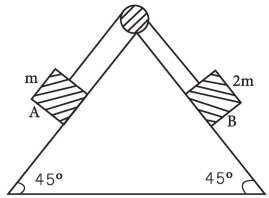
Consider the diagram shown below in which two masses of $m$ and $2 m$ are placed on a fixed triangular wedge. The coefficient of friction between block $A$ and the wedge is $2 / 3$, while that for block $B$ and the wedge is $1 / 3$
What is the value of linear velocity, if $\vec \omega = 3\hat i - 4\hat j + \hat k$ and $\vec r = 5\hat i - 6\hat j + 6\hat k$