MCQ
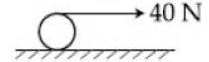
A string is wound around a hollow cylinder of mass $5\, kg$ and radius $0.5\,m$. If the string is now pulled with a horizontal force of $40\, N$, and the cylinder is rolling without slipping on a horizontal surface (see figure), then the angular acceleration of the cylinder will be ......... $rad/s^2$ .(Neglect the mass and thickness of the string)
  • A
    $20$
  • $16$
  • C
    $12$
  • D
    $10$

Answer

Correct option: B.
$16$
b
$40 + f = m\left( {R\alpha } \right)\,\,\,\,\,\,\,\,...\left( i \right)$

$40 \times R - f \times R = mR = {2^\alpha }$

$40 - f = mR\alpha \,\,\,\,\,\,\,\,\,\,\,\,\,\,...\left( {ii} \right)$

From $(i)$ and $(ii)$

$\alpha  = \frac{{40}}{{mR}} = 16$

Need a full question paper?

Generate a complete, print-ready paper with questions like this in minutes — across 16+ boards, with answer keys.

Start Generating Free

Similar questions

Which one of the following is not a conservative force
The dimensions of resistivity in terms of $M,\,L,\,T$ and $Q$ where $Q$ stands for the dimensions of charge, is
A body dropped from a height $h$ with an initial speed zero, strikes the ground with a velocity$3\,km/h$. Another body of same mass is dropped from the same height $h$ with an initial speed of $4\,km/h$ . Find the final velocity of second body with which it strikes the ground.........$km/h$
Which is the point at which all three states of matter exist are in equilibrium are called :
The force constant of a wire is $k$  and that of another wire is $2k.$ When both the wires are stretched through same distance, then the work done
Given below are two statements:

Statement $I:$ Area under velocity- time graph gives the distance travelled by the body in a given time.

Statement $II:$ Area under acceleration- time graph is equal to the change in velocity- in the given time.

In the light of given statements, choose the correct answer from the options given below.

Two vectors $\vec A$ and $\vec B$ have magnitudes $2$ and $1$ respectively. If the angle between $\vec A$ and $\vec B$ is $60^o$, then which of the following vectors may be equal to $\frac{{\vec A}}{2} - \vec B$
Consider a vector $\overrightarrow F = 4\hat i - 3\hat j.$ Another vector that is perpendicular to $\overrightarrow F $ is
The breaking stress of a wire of length $L$ and radius $r$ is $5$ $kg - wt/{m^2}$. The wire of length $2l$ and radius $2r$ of the same material will have breaking stress in $kg - wt/{m^2}$
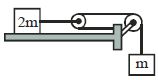
Consider the situation shown in figure. All the surfaces are smooth. The tension in the string connected to $2\,m$ is