Question
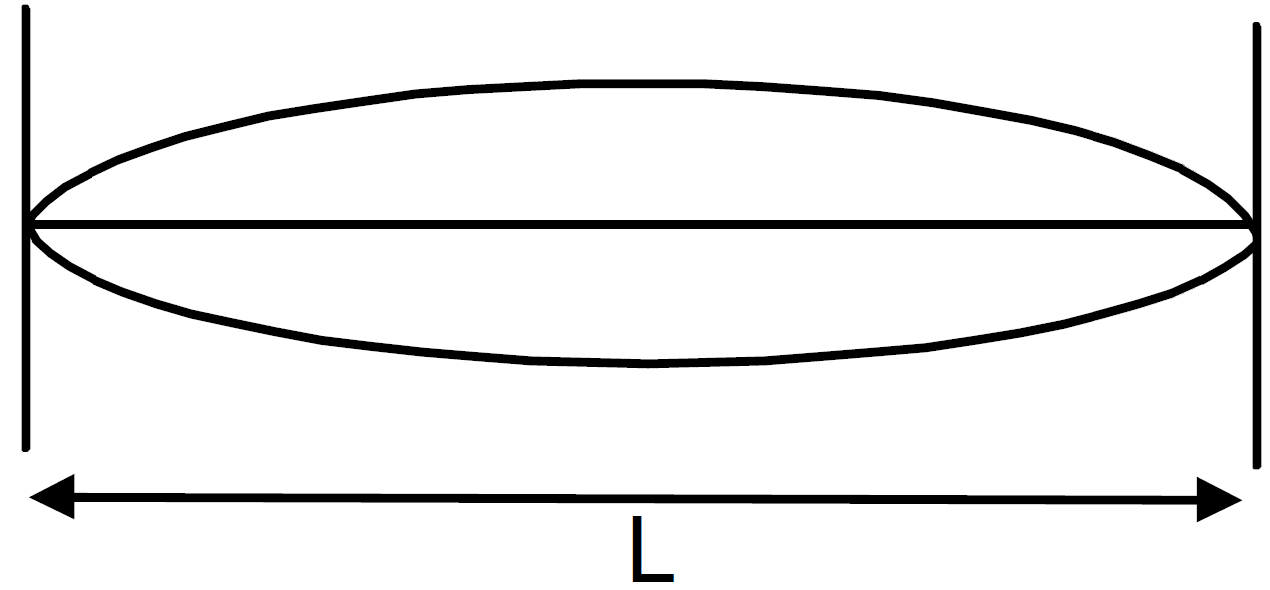
A string of length $L$ fixed at both ends vibrates in its fundamental mode at a frequency $v$ and a maximum amplitude $A.$
  1. Find the wavelength and the wave number $k.$
  2. Take the origin at one end of the string and the $X-$axis along the string. Take the $Y-$axis along the direction of the displacement. Take $t = 0$ at the instant when the middle point of the string passes through its mean position and is going towards the positive $y-$directian. Write the equation describing the standing wave:
Answer

Fundamental frequency$\text{v}=\frac{1}{2\text{l}}\sqrt{\frac{\text{T}}{\text{m}}}$
$\Rightarrow\sqrt{\frac{\text{T}}{\text{m}}}=\text{v}2\text{l}$ $\Big[\sqrt{\frac{\text{T}}{\text{m}}}=$ velocity of wave$\Big]$
  1. Wavelength, $\lambda=\frac{\text{velocity}}{\text{frequency}}=\frac{\text{v}2\text{l}}{\text{v}}=2\text{l}$
and wave number $\text{K}=\frac{2\pi}{\lambda}=\frac{2\pi}{2\text{l}}=\frac{\pi}{\text{l}}$
  1. Therefore, equation of the stationary wave is
$\text{y}=\text{A}\cos\Big(\frac{2\pi\text{x}}{\lambda}\Big)\sin\Big(\frac{2\pi\text{Vt}}{\text{L}}\Big)$
$=\text{A}\cos\Big(\frac{2\pi\text{x}}{2}\Big)\sin\Big(\frac{2\pi\text{Vt}}{\text{2L}}\Big)$
$\text{v}=\frac{\text{V}}{2\text{L}}$ $\Big[$because $\text{v}=\big(\frac{\text{v}}{2\text{l}}\big)\Big]$

Need a full question paper?

Generate a complete, print-ready paper with questions like this in minutes — across 16+ boards, with answer keys.

Start Generating Free

Similar questions

  1. Why do you prefer to use a wrench of long arm?
  2. A $3m$ long ladder weighing $20\ kg$ leans on a frictionless wall. Its feet rest on the floor $1m$ from the wall. Find the reaction forces of the wall and the floor.
If a number of little droplets of water, each of radius $r$, coalesce to form a single drop of radius $R$, show that the rise in temperature will be given by $\Delta \theta=\frac{3 \sigma}{J}\left(\frac{1}{r}-\frac{1}{R}\right)$ where $\sigma$ is the surface tension of water and J is the mechanical equivalent of heat.
 A woman throws an object of mass $500$ g with a speed of $25 m s ^1$. If the object hits a wall and rebounds with half the original speed, what is the change in momentum of the object?
A solid sphere of radius 10 cm is subjected to a uniform pressure equal to $5 \times 10^8 \mathrm{Nm}^{-2}$. Calculate the change in volume. Bulk modulus of the material of the sphere is $3.14 \times 10^{11} \mathrm{Nm}^{-2}$.
A mosquito is sitting on an L.P. record disc rotating on a turn table at $33\frac{1}{3}$ revolutions per minute. The distance of the mosquito from the centre of the turn table is 10cm. Show that the friction coefficient between the record and the mosquito is greater than $\frac{\pi^2}{81}.$ Take $g =10 m/s^2$.
A spaceship is launched into a circular orbit close to earth's surface. What additional velocity has to be imparted to the spaceship in the orbit to overcome the gravitational pull? Radius of earth = $6400km$ and $g = 9.8ms^{-2}$.
The average translational kinetic energy of air molecules is $0.040 \mathrm{eV}\left(1 \mathrm{eV}=1.6 \times 10^{-19} \mathrm{J}\right)$. Calculate the temperature of the air. Boltzmann constant $\mathrm{k}=1.38 \times 10^{-23} \mathrm{JK}^{-1}$.
When charcoal is prepared from a living tree, it shows a disintegration rate of 15.3 disintegrations of ${ }^{14} \mathrm{C}$ per gram per minute. A sample from an ancient piece of charcoal shows ${ }^{14} \mathrm{C}$ activity to be 12.3 disintegrations per gram per minute. How old is this sample? Half-life of ${ }^{14} \mathrm{C}$ is 5730 y .
Under what circumstances is the number 0 considered a significant figure.
A body travels uniformly a distance of $(13.8 \pm 0.2)\text{m}$ in a time $(4.0 \pm 0.3) \text{s}.$ What is the velocity of the body within error limits?