Question
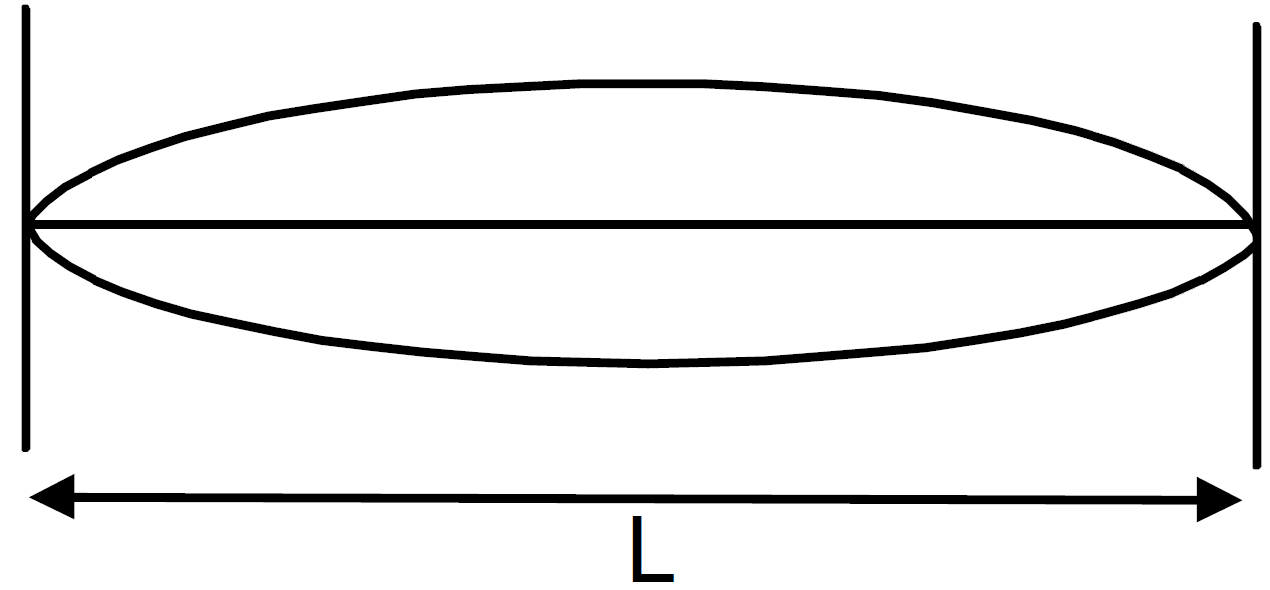
A string of length L fixed at both ends vibrates in its fundamental mode at a frequency v and a maximum amplitude A.
  1. Find the wavelength and the wave number k.
  2. Take the origin at one end of the string and the X-axis along the string. Take the Y-axis along the direction of the displacement. Take t = 0 at the instant when the middle point of the string passes through its mean position and is going towards the positive y-directian. Write the equation describing the standing wave:

Answer

Fundamental frequency$\text{v}=\frac{1}{2\text{l}}\sqrt{\frac{\text{T}}{\text{m}}}$
$\Rightarrow\sqrt{\frac{\text{T}}{\text{m}}}=\text{v}2\text{l}$ $\Big[\sqrt{\frac{\text{T}}{\text{m}}}=$ velocity of wave$\Big]$
  1. Wavelength, $\lambda=\frac{\text{velocity}}{\text{frequency}}=\frac{\text{v}2\text{l}}{\text{v}}=2\text{l}$
and wave number $\text{K}=\frac{2\pi}{\lambda}=\frac{2\pi}{2\text{l}}=\frac{\pi}{\text{l}}$
  1. Therefore, equation of the stationary wave is
$\text{y}=\text{A}\cos\Big(\frac{2\pi\text{x}}{\lambda}\Big)\sin\Big(\frac{2\pi\text{Vt}}{\text{L}}\Big)$
$=\text{A}\cos\Big(\frac{2\pi\text{x}}{2}\Big)\sin\Big(\frac{2\pi\text{Vt}}{\text{2L}}\Big)$
$\text{v}=\frac{\text{V}}{2\text{L}}$ $\Big[$because $\text{v}=\big(\frac{\text{v}}{2\text{l}}\big)\Big]$

Need a full question paper?

Generate a complete, print-ready paper with questions like this in minutes — across 16+ boards, with answer keys.

Start Generating Free

Similar questions

Figure, shows a copper rod joined to a steel rod. The rods have equal length and equal cross sectional area. The free end of the copper rod is kept at $0^\circ C$ and that of the steel rod is kept at $100^\circ C.$ Find the temperature at the junction of the rods. Conductivity of copper ${= 390Wm^{-1}}{^\circ C^{-1}.}$ and that of steel ${= 46Wm^{-1}}{^\circ c^{-1}.}$
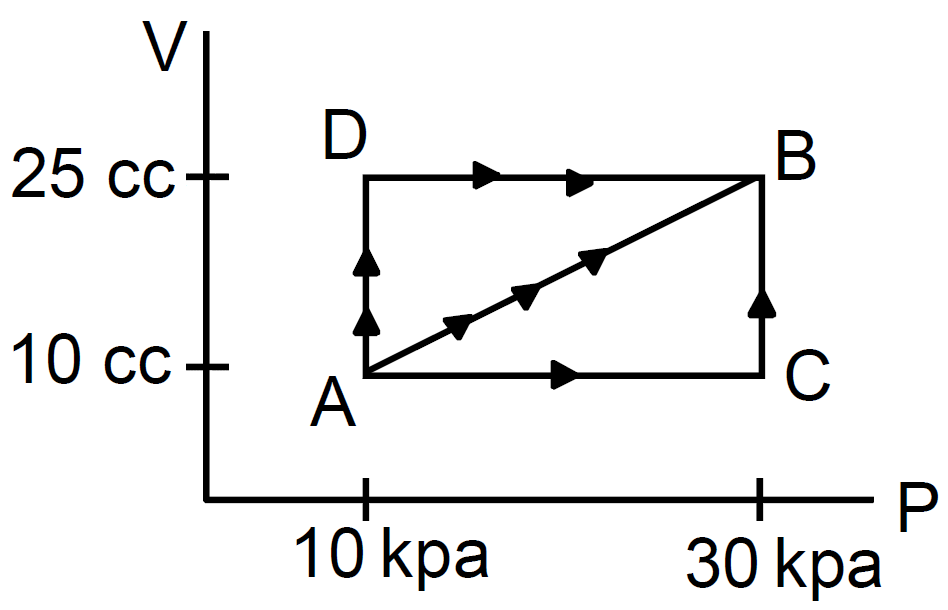
Figure. shows three paths through which a gas can be taken from the state A to the state B. Calculate the work done by the gas in each of the three paths.
Current of 4 A is flowing in a straight wire AB. A proton $P$ is travelling parallel to the wire in the opposite direction of current with a speed of $4 \times 10^6$ $m / s$ at a distance of 0.2 m from the wire as shown in the diagram. Calculate the magnitude of force applied on the proton and also tells its direction.
Explain principle, construction and working of optical fibre.
A long charged cylinder of linear charged density λ is surrounded by a hollow co-axial conducting cylinder. What is the electric field in the space between the two cylinders?
A bat emitting an ultrasonic wave of frequency $4.5 \times 10^4Hz$ flies at a speed of 6m/s between two parallel walls. Find the two frequencies heard by the bat and the beat frequency between the two. The speed of sound is 330m/s.
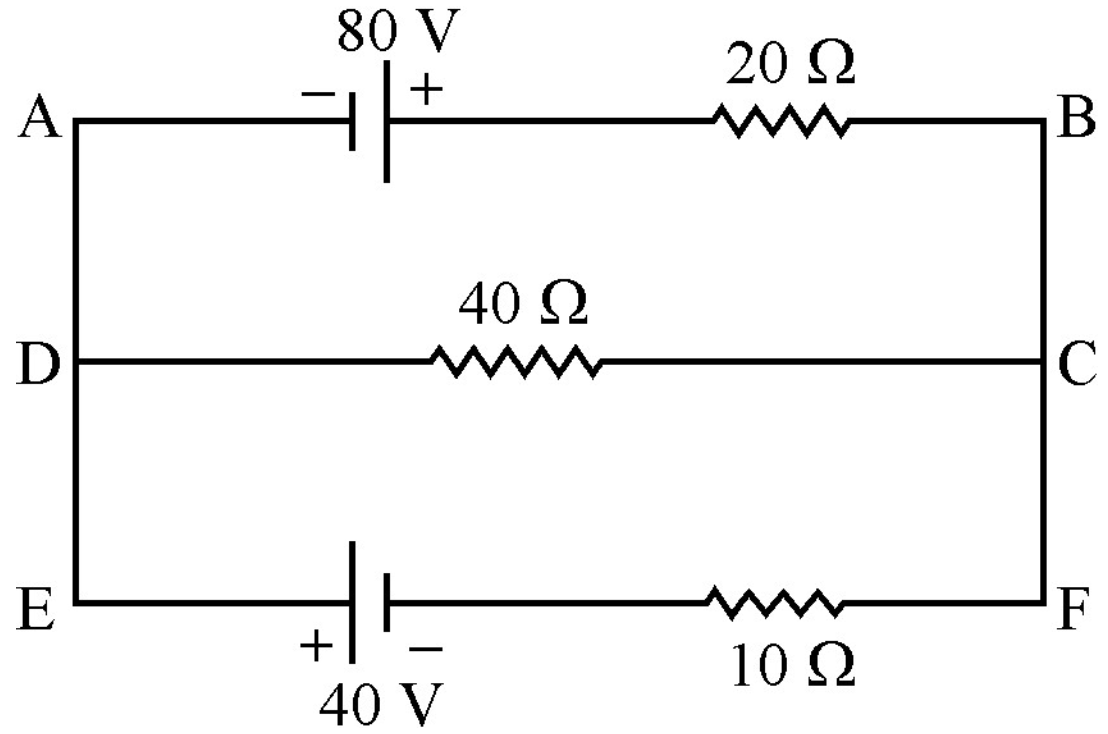
Using Kirchhoff’s rules, calculate the current through the $40\Omega$ and $20\Omega$ resistors in the following circuit:
Find the temperature at which the average thermal kinetic energy is equal to the energy needed to take a hydrogen atom from its ground state to n = 3 state. Hydrogen can now emit red light of wavelength 653.1nm. Because of Maxwellian distribution of speeds, a hydrogen sample emits red light at temperatures much lower than that obtained from this problem. Assume that hydrogen molecules dissociate into atoms.
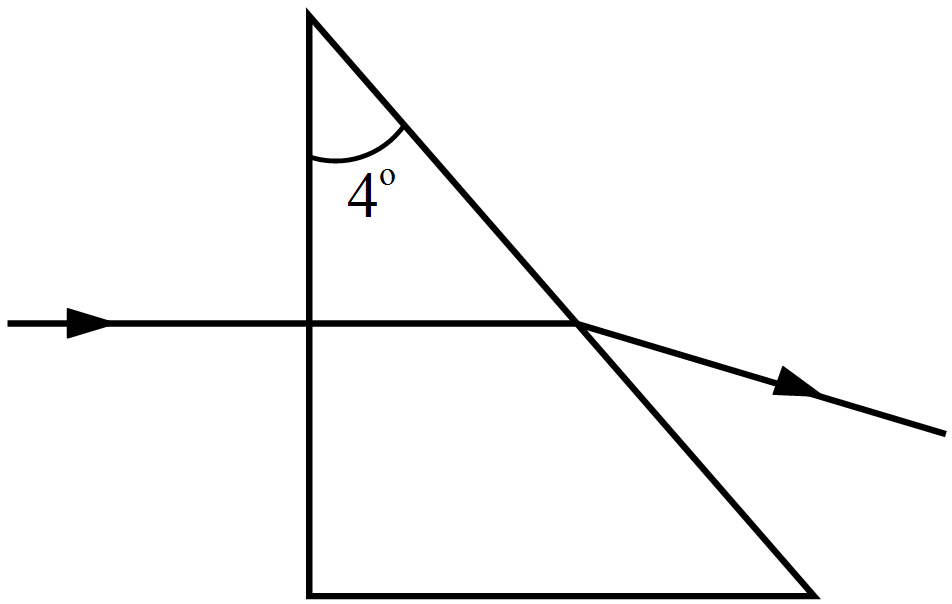
Find the angle of deviation suffered by the light ray shown in figure. The refractive index $\mu=1.5$ for the prism material.
5g of a gas is contained in a rigid container and is heated from 15°C to 25°C. Specific heat capacity of the gas at constant volume is $0.172cal-g^{-1}°C^{-1}$​​​​​​​​​​​​​​ and the mechanical equivalent of heat is $4.2J$-cal$^{-1}$. Calculate the change in the internal energy of the gas.