MCQ
A student is performing an experiment using a resonance column and a tuning fork of frequency $244 s ^{-1}$. He is told that the air in the tube has been replaced by another gas (assume that the column remains filled with the gas). If the minimum height at which resonance occurs is $(0.350 \pm 0.005) m$, the gas in the tube is

(Useful information) : $\sqrt{167 R T}=640 j^{1 / 2} mole ^{-1 / 2} ; \sqrt{140 RT }=590 j ^{1 / 2} mole ^{-1 / 2}$. The molar masses $M$ in grams are given in the options. Take the value of $\sqrt{\frac{10}{ M }}$ for each gas as given there.)

  • A
    Neon $\left(M=20, \sqrt{\frac{10}{20}}=\frac{7}{10}\right)$
  • B
    Nitrogen $\left(M=28, \sqrt{\frac{10}{28}}=\frac{3}{5}\right)$
  • C
    Oxygen $\left(M=32, \sqrt{\frac{10}{32}}=\frac{9}{16}\right)$
  • Argon (M=36, $\left.\sqrt{\frac{10}{36}}=\frac{17}{32}\right)$
Answer

Correct option: D.
Argon (M=36, $\left.\sqrt{\frac{10}{36}}=\frac{17}{32}\right)$
d
$f =\frac{1}{4 \ell} \sqrt{\frac{\gamma RT }{ M }} \& \frac{\Delta f }{ f }=\frac{\Delta \ell}{\ell}$

(A) $M=20 \times 10^{-3} \quad f =320 Hz$ $\quad\quad$$\Delta f = \pm 4.5 Hz$ Not possible

(B) $M=20 \times 10^{-3} \quad f =253 Hz$ $\quad\quad$$\Delta f = \pm 3.6 Hz$ Not possible

(C) $M=32 \times 10^{-3} \quad f =237 Hz$ $\quad\quad$$\Delta f = \pm 3.4 Hz$ Not possible

(D) $M =36 \times 10^{-3}$ $\quad$$f =242.8 Hz$ $\quad\quad$$\Delta f = \pm 3.5 Hz$ possible 

Need a full question paper?

Generate a complete, print-ready paper with questions like this in minutes — across 16+ boards, with answer keys.

Start Generating Free

Similar questions

In an isothermal process the volume of an ideal gas is halved. One can say that
A small block of mass $100\,g$ is tied to a spring of spring constant $7.5\,N / m$ and length $20\, cm$. The other end of spring is fixed at a particular point $A$. If the block moves in a circular path on a smooth horizontal surface with constant angular velocity $5\,rad / s$ about point $A$, then tension in the spring is $.........\,N$
The work of $146\,kJ$ is performed in order to compress one kilo mole of a gas adiabatically and in this process the temperature of the gas increases by $7\,^oC$ . The gas is $(R = 8.3\, J\, mol^{-1}\, K^{-1})$
The fundamental frequency in an open organ pipe is equal to the third harmonic of a closed organ pipe. If the length of the closed organ pipe is $20\, cm,$ the length of the open organ pipe is  .... $cm$
A particle is acted upon by a force of constant magnitude which is always perpendicular to the velocity of the particle, the motion of the particle takes place in a plane. It follows that
A satellite moves in a circle around the earth. The radius of this circle is equal to one half of the radius of the moon’s orbit. The satellite completes one revolution in
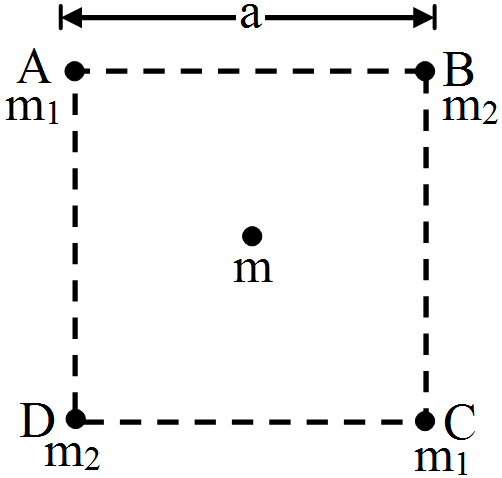
A point mass m is placed at the centre of the square ABCD of side a units as shown below.

The resultant gravitational force on mass m due to masses m1 and m2 plant on the vertices of square is:

A body of weight w1 is suspended from the ceiling of a room through a chain of weight w2. The ceiling pulls the chain by a force:
  1. w1
  2. w2
  3. w1 + w2
  4. $\frac{\text{w}_1+\text{w}_2}{2}$
The density of a material is $CGS$ system of units is $4\,g/cm^3$. In a system of units in which unit of length is $10\,cm$ and unit of mass is $100\,g$, the value of density of material will be
The average energy in one time period in simple harmonic motion is:

  1. $\frac{1}{2}\text{m}\omega^2\text{A}^2$

  2. $\frac{1}{4}\text{m}\omega^2\text{A}^2$

  3. $\text{m}\omega^2\text{A}^2$

  4. $\text{Zero}$