Question
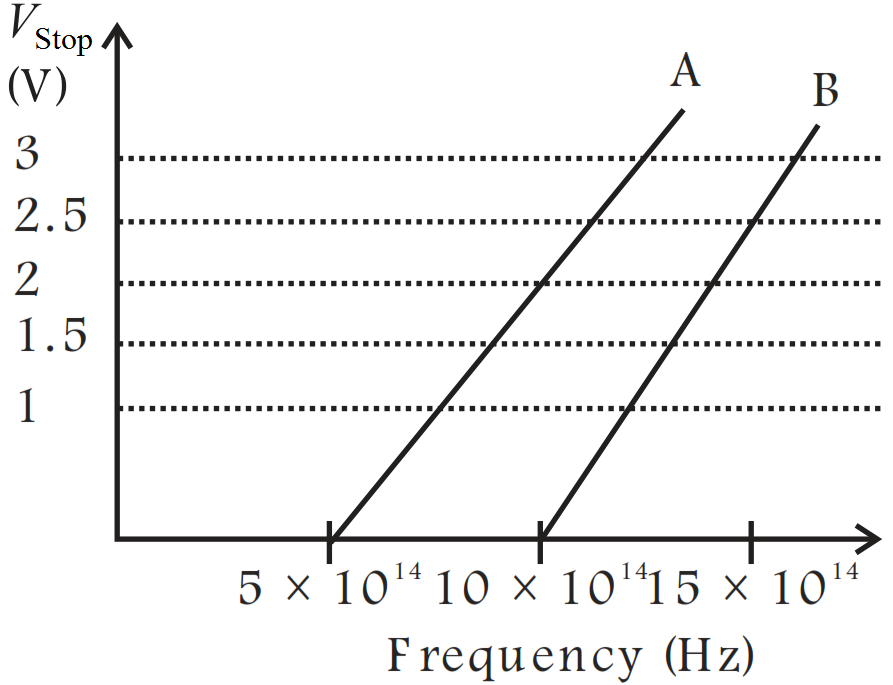
A student performs an experiment on photoelectric effect, using two materials $A$ and $B. A$ plot of $V$ stop vs $ν$ is given in Fig.
  1. Which material $A$ or $B$ has a higher work function?
  2. Given the electric charge of an electron $= 1.6 \times 10^{-19}C,$ find the value of $h$ obtained from the experiment for both $A$ and $B$.
Comment on whether it is consistent with Einstein’s theory:

Answer

  1. From the given figure, we have
Threshold frequency of $A, v_{0A} = 5 \times 10^{14}Hz$ and
Threshold frequency of $B, v_{0B} = 10 \times 10^{14}Hz$
Now,Work function, $\phi=\text{hv}_0$
$\Rightarrow\ \phi_0\propto\text{v}_0 \ [\because h \ ($Planck's constant$)$ is constant$]$
Now, $\frac{\phi_{0\text{A}}}{\phi_{0\text{B}}}=\frac{5\times10^{14}}{10\times10^{14}}$
$\Rightarrow\ \frac{\phi_{0\text{A}}}{\phi_{0\text{B}}}=\frac{1}{2}$
$\therefore\ {\phi_{0\text{A}}}<{\phi_{0\text{B}}}$
Hence, the work function of $B$ is higher than $A$.
  1. For metal $A,$
The slope is given by $\frac{\text{h}}{\text{e}}=\frac{2}{(10-5)10^{14}}$
$\Rightarrow\ \text{h}=\frac{2\text{e}}{5\times10^{14}}$
$=\frac{2\times1.6\times10^{-19}}{5\times10^{14}}\ \ \big[\because\ \text{e}=1.6\times10^{-19}\big]$
$=6.4\times10^{-34}\text{Js}$
Similarly, for metal $B,$
The slopw is given by slope $\frac{\text{h}}{\text{e}}=\frac{2.5}{(15-10)10^{14}}$
$\Rightarrow\ \text{h}=\frac{2.5\times\text{e}}{5\times10^{14}}$
$=\frac{2.5\times1.6\times10^{-19}}{5\times10^{14}}\ \ \big[\because\ 1.6\times10^{-19}\big]$
$=8\times10^{-34}\text{js}$
Since, the experimental value of $h$ for metals $A$ and $B$ is different.
Hence, the given experiment is not consistent with theory.

Need a full question paper?

Generate a complete, print-ready paper with questions like this in minutes — across 16+ boards, with answer keys.

Start Generating Free

Similar questions

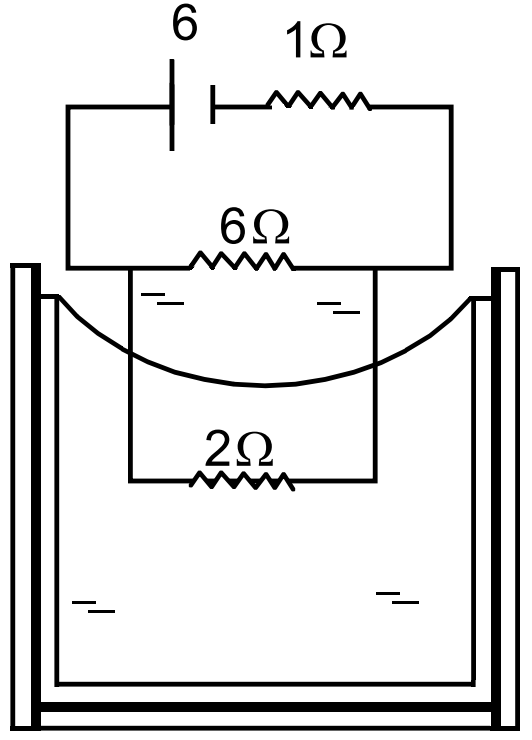
The $2.0\Omega$ resistor shown in the figure is dipped into a calorimeter containing water. The heat capacity of the calorimeter together with water is $2000JK-^1$.
  1. If the circuit is active for $15$ minutes, what would be the rise in the temperature of the water?
  2. Suppose the $6.0\Omega$ resistor gets burnt. What would be the rise in the temperature of the water in the next $15$ minutes?
Consider the fission of $^{238}_{92}\text{U}$ by fast neutrons. In one fission event, no neutrons are emitted and the final end products, after the beta decay of the primary fragments, are  $^{140}_{58}\text{Ce}$ and   $^{99}_{44}\text{Ru}.$ Calculate $Q$ for this fission process.
The relevant atomic and particle masses are:
$\text{m}(^{238}_{92}\text{U})=238.05079\text{ u}$
$\text{m}(^{140}_{58}\text{Ce})=139.90543\text{ u}$
$\text{m}(^{99}_{44}\text{Ru})=98.90594\text{ u}$
A series $\text{LCR}$ circuit with $\text{L = 0.12H, C = 480nF, R} = 23\Omega$ is connected to a $230V$ variable frequency supply.
  1. What is the source frequency for which current amplitude is maximum. Obtain this maximum value.
  2. What is the source frequency for which average power absorbed by the circuit is maximum. Obtain the value of this maximum power.
  3. For which frequencies of the source is the power transferred to the circuit half the power at resonant frequency? What is the current amplitude at these frequencies?
  4. What is the $Q-$ factor of the given circuit?
A motorcycle has to move with a constant speed on an overbridge which is in the form of a circular arc of radius R and has a total length L. Suppose the motorcycle starts from the highest point.
  1. What can its maximum velocity be for which the contact with the road is not broken at the highest point?
  2. If the motorcycle goes at speed $\frac{1}{\sqrt2}$ times the maximum found in part (a), where will it lose the contact with the road?
  3. What maximum uniform speed can it maintain on the bridge if it does not lose contact anywhere on the bridge?
Analyze the force acting on a moving charge in a uniform magnetic field.###Analyze the magnetic force acting on a moving charged particle in a magnetic field. Write the magnitude of force in different conditions. Write suitable rule for finding the direction of force.
A parallel beam of white light is incident normally on a water film $1.0 \times 10^{-4}cm$ thick. Find the wavelength in the visible range $(400\ nm - 700\ nm)$ which are strongly transmitted by the film. Refractive index of water $= 1.33.$
To ensure almost $100$ per cent transmittivity, photographic lenses are often coated with a thin layer of dielectric material. The refractive index of this material is intermediated between that of air and glass $($which makes the optical element of the lens$)$. A typically used dielectric film is $\ce{MgF_2 (n = 1.38).}$ What should the thickness of the film be so that at the center of the visible speetrum $(5000\mathring{\text{A}})$ there is maximum transmission.
Two Polaroids are placed 90° to each other and the transmitted intensity is zero. What happens when one more Polaroid is placed between these two bisecting the angle between them. Take intensity of unpolarised light 10. How will the intensity of transmitted light vary on further rotating the third Polaroid? 
The difference in the frequencies of series limit of Lyman series and Balmer series is equal to the frequency of the first line of the Lyman series. Explain.
State the Biot-Savart law for the magnetic field due to a current carrying element. Use this law to obtain a formula for magnetic field at the centre of a circular loop of radius R carrying a steady current I. Sketch the magnetic field lines for a current loop clearly indicating the direction of the field.