MCQ
A student performs an experiment to determine the Young's modulus of a wire, exactly $2 \mathrm{~m}$ long, by Searle's method. In a particular reading, the student measures the extension in the length of the wire to be $0.8 \mathrm{~mm}$ with an uncertainty of $\pm 0.05 \mathrm{~mm}$ at a load of exactly $1.0 \mathrm{~kg}$. The student also measures the diameter of the wire to be $0.4 \mathrm{~mm}$ with an uncertainty of $\pm 0.01 \mathrm{~mm}$. Take $g=9.8 \mathrm{~m} / \mathrm{s}^2$ (exact). The Young's modulus obtained from the reading is
  • A
    $(2.0 \pm 0.3) \times 10^{11} \mathrm{~N} / \mathrm{m}^2$
  • $(2.0 \pm 0.2) \times 10^{11} \mathrm{~N} / \mathrm{m}^2$
  • C
    $(2.0 \pm 0.1) \times 10^{11} \mathrm{~N} / \mathrm{m}^2$
  • D
    $(2.0 \pm 0.05) \times 10^{11} \mathrm{~N} / \mathrm{m}^2$

Answer

Correct option: B.
$(2.0 \pm 0.2) \times 10^{11} \mathrm{~N} / \mathrm{m}^2$
b
$Y =\frac{4 Fl }{\pi D ^2 e }$

Taking long both the sides

$\log Y =\log 4 Fl -\log \pi D ^2 e$

Now, partially differentiating,

$\frac{\Delta Y }{ Y }=-\left(\frac{2 \Delta D }{ D }+\frac{\Delta e }{ e }\right)$

$\frac{\Delta Y }{ Y }=-\left(\frac{2 \times 0.01}{0.4}+\frac{0.05}{0.8}\right)$

$\frac{\Delta Y }{ Y }=-0.1125$

$\text { Also, } Y =\frac{ Fl }{ Ae }=\frac{9.8 \times 2}{\pi(0.2)^2 \times 0.8}=194.96 \times 10^9 \approx 2 \times 10^{11}$

$\Delta Y =- Y \times\left(\frac{2 \Delta r }{ r }+\frac{\Delta e }{ e }\right)$

$\Delta Y =0.225 \times 10^{11}$

$Y =(2 \pm 0.2) \times 10^{11} Nm ^{-2}$

Need a full question paper?

Generate a complete, print-ready paper with questions like this in minutes — across 16+ boards, with answer keys.

Start Generating Free

Similar questions

A body of mass $2\, kg$ moving with a velocity $\left( {\hat i + \hat j + \hat k} \right)\,m/s$ collides with another body of mass $5\, kg$ moving with velocity $\left( {\hat i - 2\hat j + 3\hat k} \right)\,m/s$. If they stick together, the velocity (in $m/s$) of the composite body is 
Heat is flowing through a conductor of length l from $x = 0$ to $x = l$ . If its thermal resistance per unit length is uniform, which of the following graphs is correct
A spherical bubble inside water has radius $R$. Take the pressure inside the bubble and the water pressure to be $p_0$. The bubble now gets compressed radially in an adiabatic manner so that its radius becomes $(R-a)$. For $a \ll R$ the magnitude of the work done in the process is given by $\left(4 \pi p_0 R a^2\right) X$, where $X$ is a constant and $\gamma=C_p / C_V=41 / 30$. The value of $X$ is. . . . . .
A swimmer swims in still water at a speed $= 5\,\, km/hr$. He enters a $200\,\, m$ wide river, having river flow speed $= 4\,\, km/hr$ at point A and proceeds to swim at an angle of $127^o$ (sin $37^o = 0.6$) with the river flow direction.Another point $B$ is located directly across Aon the other side. The swimmer lands on the other bank at a point $C$, from which he walks the distance $CB$ with a speed $= 3\,\, km/hr.$ The total time in which he reachrs from $A$ to $B$ is..........$minutes$
Two stones are thrown up simultaneously from the edge of a cliff $240\ m$ high with initial speed of $10\ m/s$ and $40\ m/s$ respectively. Which of the following graph best represents the time variation of relative position of the second stone with respect to the first ?

(Assume stones do not rebound after hitting the ground and neglect air resistance, take $g = 10\ m/ s^2$)
(The figures are schematic and not drawn to scale)

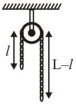
A uniform metal chain of mass $m$ and length ' $L$ ' passes over a massless and frictionless pulley. It is released from rest with a part of its length ' $l$ ' is hanging on one side and rest of its length ' $L -l$ ' is hanging on the other side of the pulley. At a certain point of time, when $l=\frac{L}{x}$, the acceleration of the chain is $\frac{g}{2}$. The value of $x$ is ........
The acceleration vector of a particle in uniform circular motion averaged over the cycle is a null vector. This statement is
A particle moves in $xy$ plane according to the law $x = a \sin \omega t$ and $y = a(1-\cos \omega t)$ where $a$ and $\omega$ are constants. The particle traces
A vibrating string of certain length $l$ under a tension $T$ reasonates with a mode corresponding to the first overtone (third harmonic) of an air column of length $75$ $cm$ inside a tube closed at one end. The string also generates $4$ beats per second when excited along with a tuning fork of frequency $n$. Now when the tension of the string is slightly increased the number of beats reduces to $2$ per second. Assuming the velocity of sound in air to be $340$ $m/s$, the frequency $n$ of the tuning fork in $Hz $ is
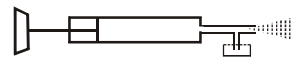
A spray gun is shown in the figure where a piston pushes air out of a nozzle. A thin tube of uniform cross section is connected to the nozzle. The other end of the tube is in a small liquid container. As the piston pushes air through the nozzle, the liquid from the container rises into the nozzle and is sprayed out. For the spray gun shown, the radii of the piston and the nozzle are $20 \ mm$ and $1 \ mm$ respectively. The upper end of the container is open to the atmosphere. $Image$

$1.$ If the piston is pushed at a speed of $5 \ mms ^{-1}$, the air comes out of the nozzle with a speed of

$(A)$ $0.1 \ ms ^{-1}$ $(B)$ $1 \ ms ^{-1}$ $(C)$ $2 \ ms ^{-1}$ $(D)$ $8 \ ms ^{-1}$

$2.$ If the density of air is $\rho_{ a }$ and that of the liquid $\rho_{\ell}$, then for a given piston speed the rate (volume per unit time) at which the liquid is sprayed will be proportional to

$(A)$ $\sqrt{\frac{\rho_{ a }}{\rho_{\ell}}}$ $(B)$ $\sqrt{\rho_a \rho_{\ell}}$ $(C)$ $\sqrt{\frac{\rho_{\ell}}{\rho_{ a }}}$ $(D)$ $\rho_{\ell}$

Give the answer question $1$ and $2.$