MCQ
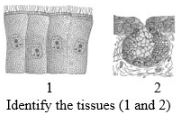
A student was given a sample of two tissues. He observes the tissues under the microscope and draws their figures ( $1\;and\;2$) as shown below.
  • A
    $1$: Columnar cells bearing cilia; $2$: Unicellular glandular epithelium
  • B
    $1$: Cuboidal cells bearing cilia; $2$: Multicellular glandular epithelium
  • C
    $1$: Compound cells bearing cilia; $2$: Unicellular glandular epithelium
  • $1$: Columnar cells bearing cilia; $2$: Multicellular glandular epithelium

Answer

Correct option: D.
$1$: Columnar cells bearing cilia; $2$: Multicellular glandular epithelium
d
Tissue $1$ is columnar cells bearing cilia and tissue $2$ is multicellular glandular epithelium. Ciliated columnar epithelial cells possess fine hairlike outgrowths, cilia on their free surfaces. These cilia are capable of rapid, rhythmic, wavelike beatings in a certain direction. This movement of the cilia in a certain direction causes the mucus, which is secreted by the goblet cells, to move (flow or stream) in that direction. Ciliated epithelium is usually found in the air passages like the nose. It is also found in the uterus and fallopian tubes of females. Columnar epithelium with goblet cells is called glandular epithelium. Some parts of the glandular epithelium consist of such a large number of goblet cells that there are only a few normal epithelial cells left.

Need a full question paper?

Generate a complete, print-ready paper with questions like this in minutes — across 16+ boards, with answer keys.

Start Generating Free