Question

A study of binary stars is most helpful in

(a) Finding their distances

(b) Finding their temperature

(c) Finding their masses

(d) Verifying Newton's force law of gravitation

Answer

(d) Verifying Newton's force law of gravitation

Need a full question paper?

Generate a complete, print-ready paper with questions like this in minutes — across 16+ boards, with answer keys.

Start Generating Free

Similar questions

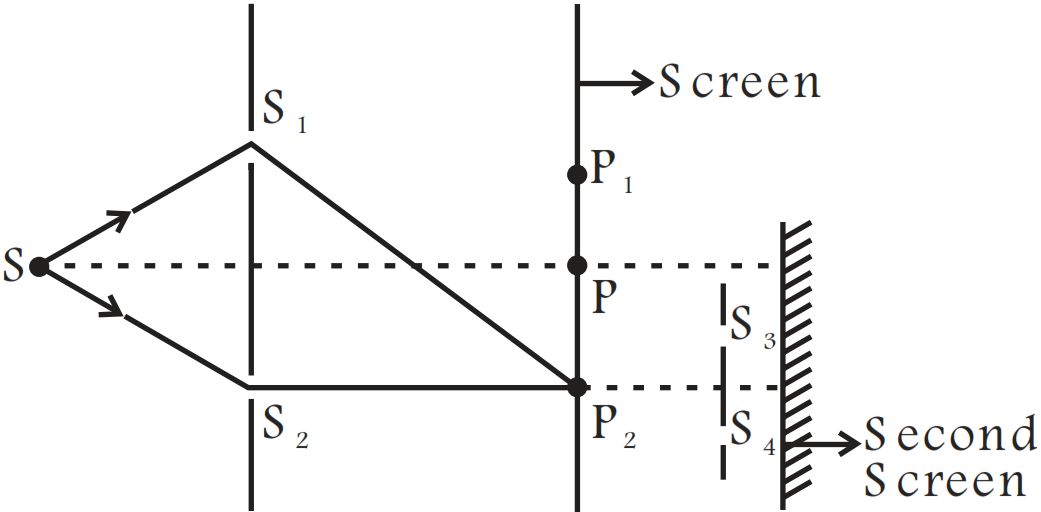
Figure shows a standard two slit arrangement with slits S1, S2. P1, P2 are the two minima points on either side of P (Fig). At P2 on the screen, there is a hole and behind P2 is a second 2- slit arrangement with slits S3, S4 and a second screen behind them.

For depositing 1 gm of Cu in copper voltameter on passing 2 amperes of current, the time required will be (For copper  Z = 0.00033 gm/C)

(a) Approx. 20 minutes

(b) Approx. 25 minutes

(c) Approx. 30 minutes

(d) Approx. 35 minutes

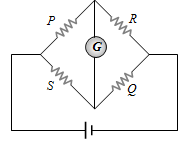
In the circuit given, the correct relation to a balanced Wheatstone bridge is

(a)  

(b)

(c)    

(d) None of these

What is the de-Broglie wavelength of the α - particle accelerated through a potential difference V

(a)  Å

(b) Å

(c) Å

(d) Å

A magnet whose magnetic moment is $50 \hat{i} Am ^2$. It is kept in an magnetic field $\vec{B}=(0.5 \hat{i}+3.0 \hat{j}) T$ along the direction of $x$-axis. The torque acting on the magnet is :
A positive charge is moving vertically upwards in the magnetic field towards the south. In which direction will it be deflected?

Fission of nuclei is possible because the binding energy per nucleon in them

(a) Increases with mass number at high mass numbers

(b) Decreases with mass number at high mass numbers

(c) Increases with mass number at low mass numbers

(d) Decreases with mass number at low mass numbers

Two equal charges q are placed at a distance of 2a and a third charge -2q is placed at the midpoint. The potential energy of the system is

(a)  

(b)

(c)

(d)

The energy of an atom (or ion) in its ground state is -54.4eV. It may be:
  1. Hydrogen.
  2. Deuterium.
  3. He+
  4. Li++

The photoelectric threshold wavelength for a metal surface is 6600 Å. The work function for this is

(a) 1.87 V

(b) 1.87 eV

(c) 18.7 eV

(d) 0.18 eV