MCQ
A substance (initial concentration $= a$) reacts according to zero order kinetics. The time taken for the completion of reaction is nearly
  • $a/k$
  • B
    $a/2k$
  • C
    $k/a$
  • D
    $2k/a$

Answer

Correct option: A.
$a/k$
a
${{\text{t}}_{{\text{completion }}}} = 2 \times {{\text{t}}_{1/2}}$

( $\because $ Rate is constt. in zero order)

${{\text{t}}_{{\text{completion }}}} = 2 \times \frac{{\text{a}}}{{2{\text{k}}}} = \frac{{\text{a}}}{{\text{k}}}$

Need a full question paper?

Generate a complete, print-ready paper with questions like this in minutes — across 16+ boards, with answer keys.
Start Generating Free

Similar questions

On increasing the temperature, the rate of the reaction increases because of
In above reaction out of the following which will be obtained in maximum yield
Function of enzymes in the living system is to
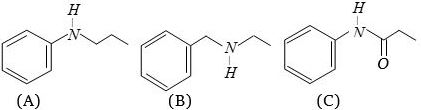
Which one of the following compound is most basic ?
The osmotic pressures of $0.010\,\,M$  solutions of  $KI$  and of sucrose $(C_{12}H_{22}O_{11})$  are $0.432\,\,atm$  and  $0.24\,\,atm$  respectively. The van't Hoff factor for $KI$  is
On hydrolysis of a "compound", two compounds are obtained. One of which on treatment with sodium nitrite and hydrochloric acid gives a product which does not respond to iodoform test. The second one reduces Tollens reagent and Fehling's solution. The "compound" is
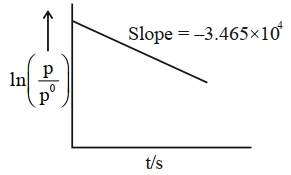
For the decomposition of azomethane. $CH _{3} N _{2} CH _{3}( g ) \rightarrow CH _{3} CH _{3}( g )+ N _{2}$ (g) a first order reaction, the variation in partial pressure with time at $600\,K$ is given as
In which reaction ethyl phenyl ketone is obtained
An unknown compound $(A)$ (molarmass $= 180$) on acylation gives a product  (molar mass $= 390$) than find the number of hydroxyl group present in  compound $(A)$ .
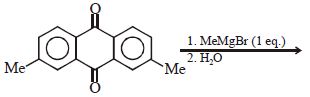
To carry out above conversion, arrange the following reagents in correct order

$\begin{matrix}
   {{O}_{3}}/Zn  \\
   (1)  \\
\end{matrix}\,\,\,\,\,\,\,\,\,\,\begin{matrix}
   EtONa/EtOH/\Delta   \\
   (2)  \\
\end{matrix}\,\,\,\,\,\,\,\,\,\,\,\begin{matrix}
   NaOCl  \\
   (3)  \\
\end{matrix}\,\,\,\,\,\,\,\,\,\begin{matrix}
   {{H}^{+}}  \\
   (4)  \\
\end{matrix}$