MCQ
A system can be taken from the initial state $\mathrm{p}_1, \mathrm{~V}_1$ to the final state $\mathrm{p}_2, \mathrm{~V}_2$ by two different methods. Let $\Delta\text{Q}$ and $\Delta\text{W}$ represent the heat given to the system and the work done by the system. Which of the following must be the same in both the methods?
  • A
    $\Delta\text{Q}$
  • B
    $\Delta\text{W}$
  • C
    $\Delta\text{Q}+\Delta\text{W}$
  • $\Delta\text{Q}-\Delta\text{W}$

Answer

Correct option: D.
$\Delta\text{Q}-\Delta\text{W}$
​A system is taken from an initial state to the final state by two different methods.
So, work done and heat supplied in both the cases will be different as they depend on the path followed. On the other hand, internal energy of the system $(U)$ is a state function, i.e. it only depends on the final and initial state of the process. They are the same in the above two methods.
Using the first law of thermodynamics, we get,
$\Delta\text{Q}=\Delta\text{U}+\Delta\text{W}$
$\Rightarrow\Delta\text{U}=\Delta\text{Q}-\Delta\text{W}$
Here, $\Delta\text{U}$ is the change in internal energy, $\Delta\text{Q}$ is the heat given to the system and $\Delta\text{W}$ is the work done by the system.

Need a full question paper?

Generate a complete, print-ready paper with questions like this in minutes — across 16+ boards, with answer keys.

Start Generating Free

Similar questions

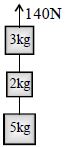
What will be the acceleration of blocks and tension in the string connecting the blocks $2\,kg$ and $5\,kg$ for the given figure :-
The time period T of a small drop of liquid (due to surface tension) depends on density $\rho$, radius r and surface tension S. The relation is:
What is ratio of surface energy of $1$ small drop and $1$ large drop, if $1000$ small drops combined to form $1$ large drop
Suppose a container ia evacuated to leave just one molecule of a gas in it. Let $V_a$ and $v_{rms}$ represent the average speed and the $\text{rms}$ speed of the gas.
The two thin bones $($femurs$),$ each of cross$-$sectional area $10\ cm^2$ support the upper part of human body of mass $40 \ kg.$ Estimate the average pressure sustained by the femurs:
Work done by gravitational force in one revolution of the earth around the sun on its elliptical path is zero because:
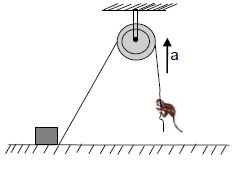
A light string fixed at one end to a clamp on ground passes over a fixed pulley and hangs at the other side. It makes an angle of $30^o$ with the ground. A monkey of mass $5\ kg$ climbs up the rope. The clamp can tolerate a vertical force of $40\ N$ only. The maximum acceleration in upward direction with which the monkey can climb safely is ............ $m/s^2$ (neglect friction and take $g = 10\ m / s^2$ )
A hospital uses an ultrasonic scanner to locate tumours in a tissue. The operating frequency of scanner is $4.2MHz.$ The speed of sound in the tissue is $1.7\ km s^{-1}$. The wavelength of sound in the tissue is close to:
A uniform metallic wire is elongated by $0.04\, m$ when subjected to a linear force $F$. The elongation, if its length and diameter is doubled and subjected to the same force will be ..... $cm .$
Two forces having magnitude $A$ and $\frac{ A }{2}$ are perpendicular to each other. The magnitude of their resultant is