MCQ
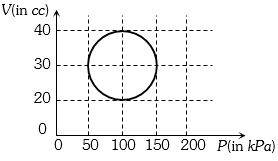
A system is taken through a cyclic process represented by a circle as shown. The heat absorbed by the system is
  • A
    $\pi \times {10^3}J$
  • $\frac{\pi }{2}J$
  • C
    $4\pi \times {10^2}J$
  • D
    $\pi \,J$

Answer

Correct option: B.
$\frac{\pi }{2}J$
b
(b) In cyclic process $\Delta  Q =$ Work done = Area inside the closed curve.

Treat the circle as an ellipse of area $ = \frac{\pi }{4}({P_2} - {P_1})\,({V_2} - {V_1})$

$\Rightarrow \Delta Q = \frac{\pi }{4}\{ (150 - 50) \times {10^3}\} = \frac{\pi }{2}J$

Need a full question paper?

Generate a complete, print-ready paper with questions like this in minutes — across 16+ boards, with answer keys.
Start Generating Free

Similar questions

An infinitely long rod lies along the axis of a concave mirror of focal length $f$. The near end of the rod is at a distance $u >f$ from the mirror. Its image will have a length 
On adjusting the $P-N $junction diode in forward biased
The quantities remaining constant in a collision are
A uniform magnetic field of $2 \times 10^{-3} T$ acts along positive $Y-$direction. A rectangular loop of sides $20 \ cm$ and $10 \ cm$ with current of $5 A$ is $Y-Z$ plane. The current is in anticlockwise sense with reference to negative $X$ axis. Magnitude and direction of the torque is $:$
Radiation of two photon energies twice and five times the work function of metal are incident sucessively on the metal surface. The ratio of the maximum velocity of photoelectrons emitted is the two cases will be
The earth revolves round the sun in one year. If the distance between them becomes double, the new period of revolution will be
A ball is released from a height of $10\, m$. If after the impact there is loss of $40\%$ in its  energy, the ball shall rise upto- ................. $\mathrm{m}$
The value of densities of two diatomic gases at constant temperature and pressure are ${d_1}$ and ${d_2}$, then the ratio of speed of sound in these gases will be
$A$ small ball $B$ of mass $m$ is suspended with light inelastic string of length $L$ from $a$ block $A$ of same mass $m$ which can move on smooth horizontal surface as shown in the figure. The ball is displaced by angle $\theta$ from equilibrium position & then released. The displacement of block when ball reaches the equilibrium position is
A rope ladder with a length $l$ carrying a man with a mass $m$ at its end is attached to the basket of balloon with a mass $M.$ The entire system is in equilibrium in the air. As the man climbs up to the end of the ladder into the balloon, the balloon descends by a height $h.$ Then the potential energy of the man