Question
A table with smooth horizontal surface is placed in a cabin which moves in a circle of a large radius R (figure In). A smooth pulley of small radius is fastened to the table. Two masses m and 2m placed on the table are connected through a string going over the pulley. Initially the masses are held by a person with the strings along the outward radius and then the system is released from rest (with respect to the cabin). Find the magnitude of the initial acceleration of the masses as seen from the cabin and the tension in the string.

Answer


Let the bigger mass accelerates towards right with ‘a’.
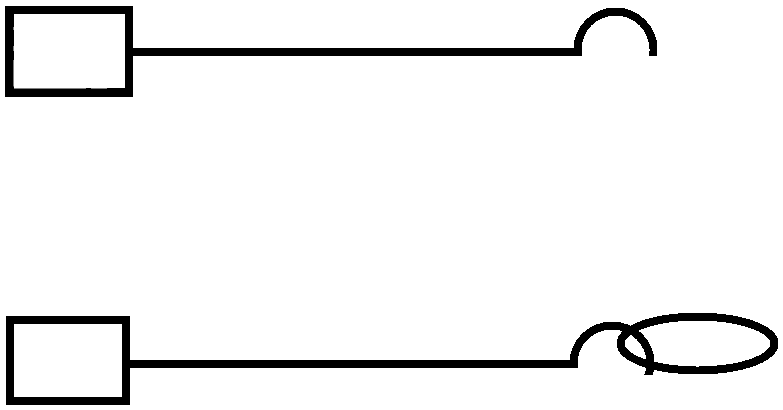
From the free body diagrams,
$\text{T}-\text{ma}-\text{m}\omega^2\text{R}=0\ \dots(1)$
$\text{T}+2\text{ma}-2\text{m}\omega^2\text{R}=0\ \dots(2)$
Eq (1) – Eq (2)
$\Rightarrow3\text{ma}=\text{m}\omega^2\text{R}$
$\Rightarrow\text{a}=\frac{\text{m}\omega^2\text{R}}{3}$
Substituting the value of a in Equation (1), we get $\text{T}=\frac{4}{3}\text{m}\omega^2\text{R}.$

Need a full question paper?

Generate a complete, print-ready paper with questions like this in minutes — across 16+ boards, with answer keys.

Start Generating Free

Similar questions

Figure shows a light rod of length l rigidly attached to a small heavy block at one end and a hook at the other end. The system is released from rest with the rod in a horizontal position. There is a fixed smooth ring at a depth h below the initial position of the hook and the hook gets into the ring as it reaches there. What should be the minimum value of h so that the block moves in a complete circle about the ring?
$2g$ of hydrogen is sealed in a vessel of volume $0.02m^3$ and is maintained at $300K$. Calculate the pressure in the vessel.
A player throws a ball upwards with an initial speed of $29.4m s^{–1}$. Choose the $x = 0m$ and $t = 0s$ to be the location and time of the ball at its highest point, vertically downward direction to be the positive direction of x-axis, and give the signs of position, velocity and acceleration of the ball during its upward, and downward motion.
The force experienced by a mass moving with a uniform speed v in a circular path of radius experiences a force which depends on its mass, speed and radius. Prove that the relation is $\text{f}=\frac{\text{mv}^2}{\text{r}}$
A particle starts rotating from rest and displaces according to the formula. $\theta=\frac{3\text{t}^3}{20}-\frac{\text{t}^2}{3}$ Calculate the angular velocity and angular acceleration at the end of 5sec.
What should be the condition for the efficiency of a Carnot engine to be equal to 1?
Arocket with a lift off mass $20,000 \mathrm{~kg}$ is blasted upwards with an initial acceleration of $5.0 \mathrm{~ms}^{-2}$. Calculate the initial thrust (force) of the blast.
Figure. shows a vessel partitioned by a fixed diathernnc separator. Different ideal gases are filled in the two parts. The rms speed of the molecules in the left part equals the mean speed of the molecules in the right part. Calculate the ratio of the mass of a molecule in the left part to the mass of a molecule in the right part.
A light ray, going through a prism with the angle of prism 60°, is found to deviate by 30°. What limit on the refractive index can be put from these data?
There are two displacement vectors, one of magnitude $3$ metres and the other of $4$ metres. How would the two vectors be added so that the magnitude of the resultant vector be $(a)\  7$ metres $(b)\  1$ metre and $(c)\  5$ metres?