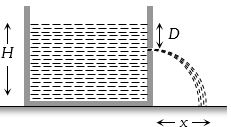
A tank is filled with water up to a height $H$. Water is allowed to come out of a hole $ P$ in one of the walls at a depth $ D $ below the surface of water. Express the horizontal distance $x$ in terms of $ H $ and $D$
Diffcult


Download our appand get started for free
Experience the future of education. Simply download our apps or reach out to us for more information. Let's shape the future of learning together!No signup needed.*
Similar Questions
- 1The pressure at the bottom of a tank of water is $3P$ where $P$ is the atmospheric pressure . If the water is drawn out till the level of water is lowered by one fifth., the pressure at the bottom of the tank will now beView Solution
- 2View SolutionThe coefficient of viscosity for hot air is
- 3View SolutionA liquid is flowing in a horizontal pipe of non-uniform cross section. Which of the following quantities may remain unchanged with respect to time?
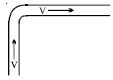
- 4A fire hydrant delivers water of density $\rho$ at a volume rate $L$. The water travels vertically upward through the hydrant and then does $90^o $ turn to emerge horizontally at speed $V$. The pipe and nozzle have uniform crosssection throughout. The force exerted by the water on the corner of the hydrant isView Solution
- 5Two capillaries of same length and radii in the ratio $1 : 2$ are connected in series. A liquid flows through them in streamlined condition. If the pressure across the two extreme ends of the combination is $ 1 m$ of water, the pressure difference across first capillary is...... $m$View Solution
- 6In an experiment to verify Stokes law, a small spherical ball of radius $r$ and density $\rho$ falls under gravity through a distance $h$ in air before entering a tank of water. If the terminal velocity of the ball inside water is same as its velocity just before entering the water surface, then the value of $h$ is proportional to :View Solution
(ignore viscosity of air)
- 7If pressure at half the depth of a lake is equal to $2/3$ pressure at the bottom of the lake then what is the depth of the lake ........ $m$View Solution
- 8Alaminar stream is flowing vertically down from a tap of cross-section area $1$ $cm^2$. At a distance $10 $ $cm$ below the tap, the cross-section area of the stream has reduced to $1/2$ $cm^2$. The volumetric flow rate of water from the tap must be about ........ $litre/\min$View Solution
- 9What will be the nature of flow of water from a circular tap, when its flow rate increased from $0.18\, L / min$ to $0.48\, L / min$ ? The radius of the tap and viscosity of water are $0.5\, cm$ and $10^{-3}\, Pa s$, respectively.View Solution
(Density of water : $10^{3}\, kg / m ^{3}$ )
- 10Sixty four spherical rain drops of equal size are falling vertically through air with terminal velocity $1.5\, m/s$. All of the drops coalesce to form a big spherical drop, then terminal velocity of big drop is ........... $m/s$View Solution