MCQ
A taut string at both ends vibrates in its $n^{th}$ overtone. The distance between adjacent Node and Antinode is found to be $'d'$. If the length of the string is $L,$ then
  • $L = 2d (n + 1)$
  • B
    $L = d (n + 1)$
  • C
    $L = 2dn$
  • D
    $L = 2d (n - 1)$

Answer

Correct option: A.
$L = 2d (n + 1)$
a
For a taut string between two ends$:$

$n^{\text {th}}$overtone$=(n+1)$harmonic

$n^{\text {th}}$overtone$=(n+1)$harmonic

$\frac{(n+1)}{2} \lambda=L \ldots \ldots \ldots .(L=\text {lengtho $f$ string}) \ldots \ldots \ldots .(1)$

Distance between node and antinode is given by $\frac{\lambda}{4}$ which is equal to $”d”$  according to

the question. $\left(\frac{\lambda}{4}=d o r \lambda=4 d\right)$

Substituting the value of $\mathrm{d}$ in equation $(1)$

$\frac{(n+1) 4 d}{2}=L$

$(n+1) 2 d=L$

Need a full question paper?

Generate a complete, print-ready paper with questions like this in minutes — across 16+ boards, with answer keys.
Start Generating Free

Similar questions

A liquid is kept in a cylindrical jar, which is rotated about the cylindrical axis. The liquid rises at its ends. The radius of the jar is $r$ and speed of rotation is $\omega$. The difference in height at the centre and the sides of jar is
A circular disc of radius $R$ is removed from a bigger uniform circular disc of radius $2R$ such that the circumferences of the discs coincide. The centre of mass of the new  disc is $\alpha R$ from the centre of the bigger disc. The value of $\alpha$ is
The height at which the acceleration due to gravity becomes $\frac{g}{9}$ (where $g$ = the acceleration due to gravity on the surface of the earth) in terms of $R$, the radius of the earth, is
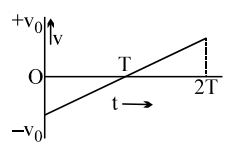
The figure shows the velocity $(v)$ of a particle plotted against time $(t)$
In a vernier callipers, $(N+1)$ divisions of vernier scale coincide with $N$ divisions of main scale. If $1 \mathrm{MSD}$ represents $0.1 \mathrm{~mm}$, the vernier constant (in $\mathrm{cm}$ ) is:
Two bodies at different temperatures are mixed in a calorimeter. Which of the following quantities remains conserved?
The average kinetic energy of a gas molecule at $27^oC$ is $6.21 \times {10^{ - 21}}\,J$. Its average kinetic energy at $227°C$ will be
An express train is moving with a velocity $v_1$. Its driver finds another train is moving on the same track in the same direction with velocity $v_2$. To escape collision, driver applies a retardation a on the train. the minimum time of escaping collision will be
A brass cube of side $a$ and density $\rho$ is floating in mercury of density $\sigma$. If the cube is displaced a bit vertically, it executes $S.H.M.$ Its time period will be
The wavelength of maximum emitted energy of a body at $700 K$ is $4.08$  $\mu m$. If the temperature of the body is raised to $1400 K$ , the wavelength of maximum emitted energy will be ........ $\mu m$