MCQ
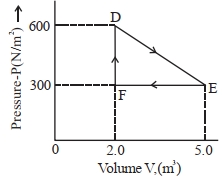
A thermodynamic system is taken from an original state $D$ to an intermediate state $E$ by the linear process shown in the figure. Its volume is then reduced to the original volume from $E$ to $F$ by an isobaric process. The total work done by the gas from $D$ to $E$ to $F$ will be $......J$
  • A
    $-450$
  • $450$
  • C
    $900$
  • D
    $1350$

Answer

Correct option: B.
$450$
b
$W _{ DE }=\frac{1}{2}(600+300) 3\,J$

$=1350\,J$

$W _{ EF }=-300 \times 3=-900\,J$

$W _{ DEF }=450\,J$

Need a full question paper?

Generate a complete, print-ready paper with questions like this in minutes — across 16+ boards, with answer keys.

Start Generating Free

Similar questions

A body is moving according to the equation $x = at + b{t^2} - c{t^3}$ where $x = $ displacement and $a,\;b$ and $c$ are constants. The acceleration of the body is
A piece of cloud having area $25 \times {10^6}\,{m^2}$ and electric potential of ${10^5}$ $volts$. If the height of cloud is $0.75\,km$, then energy of electric field between earth and cloud will be.....$J$
The material of fuse wire should have
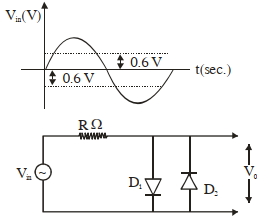
In the given circuit the input voltage $V _{\text {in }}$ is shown in figure. The cut-in voltage of $p - n$ junction diode ( $D_{1}$ or $D_{2}$ ) is $0.6\,V$. Which of the following output voltage $\left( V _{0}\right)$ waveform across the diode is correct?
The time period of oscillations of a simple pendulum is $1$ minute. If its length is increased by $44 \%$. then its new time period of oscillation will be ......... $s$
A transistor is used in common emitter mode as an amplifier. Then
A bus moving along a straight highway with speed of $72 \mathrm{~km} / \mathrm{h}$ is brought to halt within $4 \mathrm{~s}$ after applying the brakes. The distance travelled by the bus during this time (Assume the retardation is uniform) is__________.$\mathrm{m}$.
Two point masses of mass $m_1 = fM$ and $m_2 = (1 -f)\,M\,(f < 1 )$ are in outer space ( far from gravitational influence of other objects) at a distance $R$ from each other. They move in circular orbits about their centre of mass with angular vaocities $\omega _1$ for $m_1$ and $\omega _2$ for $m_2.$ In that case
The wavelength $21 cm$ emitted by atomic hydrogen in interstellar space belongs to
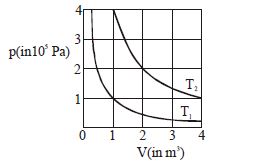
The given diagram shows isotherms for a fixed mass of an ideal gas at temperature $T_1$ and $T_2$ . What is the value of the ratio $\frac{{{\text{r}}{\text{.m}}{\text{.s}}{\text{. speed of the molecules at temperature }}{{\text{T}}_{2{\text{ }}}}}}{{{\text{r}}{\text{.m}}{\text{.s}}{\text{. speed of the molecules at temperature }}{{\text{T}}_1}}}$ ?