Question
A thick wire is stretched so that its length become two times. Assuming that there is no change in its density, then what is the ratio of change in resistance of wire to the initial resistance of wire(a) 2 : 1(b) 4 : 1(c) 3 : 1(d) 1 : 4
       

Answer

(c) 3 : 1

Need a full question paper?

Generate a complete, print-ready paper with questions like this in minutes — across 16+ boards, with answer keys.
Start Generating Free

Similar questions

Refer to the arrangement of charges in Fig. and a Gaussian surface of radius R with Q at the centre. Then:
A bar magnet of magnetic moment $m$ when kept in a maenetic field of intensity $\vec{B}$ experiences a torgue:
At a specific instant emission of radioactive compound is deflected in a magnetic field. The compound can emit
$(i)$ Electrons $(ii)$ Protons $(iii) \ \mathrm{He}^{2+} (IV)$ Neutrons. The emission at the instant can be
The image distance of an object placed 10 cm in front of a thin lens of focal length + 5 cm is(a) 6.5 cm(b) 8.0 cm(c) 9.5 cm(d) 10.0 cm
       
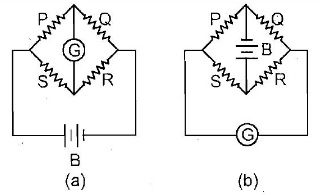
Figure (a) below shows a Wheatstone bridge in which P, Q, R, S are fixed resistances, G is a galvanometer and B is a battery. For this particular case the galvanometer shows zero deflection. Now, only the positions of B and G are interchanged,. as shown in figure (b). The new deflection of the galvanometer.
When a glass rod is rubbed with silk, it(a) Gains electrons from silk(b) Gives electrons to silk(c) Gains protons from silk(d) Gives protons to silk
   
   
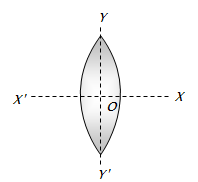
An equiconvex lens is cut into two halves along $\ce{(i) XOX¢}$ and $\ce{(ii) YOY¢}$ as shown in the figure. Let $\ce{f, f ¢, f ¢¢}$ be the focal lengths of the complete lens, of each half in case $(i),$ and of each half in case $(ii),$ respectively

Choose the correct statement from the following
A transverse wave travels along the Z-axis. The particles of the medium must move:
  1. Along the Z-axis
  2. Along the X-axis
  3. Along the Y-axis
  4. In the X-Y plane.
One of the specialties of nuclear reactions is that in their disintegrated or fused part :
The capacity of parallel plate condenser depends on (a) The type of metal used(b) The thickness of plates(c) The potential applied across the plates(d) The separation between the plates