MCQ
A thin bar of length $L$ has a mass per unit length $\lambda $, that increases linearly with distance from one end. If its total mass is $M$ and its mass per unit length at the lighter end is $\lambda_0$, then the distance of the centre of mass from the lighter end is
  • A
    $\frac{L}{2} - \frac{{{\lambda _0}{L^2}}}{{4M}}$
  • B
    $\frac{L}{3} + \frac{{{\lambda _0}{L^2}}}{{8M}}$
  • $\frac{L}{3} + \frac{{{\lambda _0}{L^2}}}{{4M}}$
  • D
    $\frac{{2L}}{3} - \frac{{{\lambda _0}{L^2}}}{{6M}}$
Answer

Correct option: C.
$\frac{L}{3} + \frac{{{\lambda _0}{L^2}}}{{4M}}$
c
Mass per unit lengh $=\lambda_{0}+\mathrm{kx}$

$\mathrm{M}=\int_{0}^{\mathrm{L}}\left(\lambda_{0}+\mathrm{kx}\right) \mathrm{dx}$

$M=\lambda_{0} L+\frac{K \times L^{2}}{2}$

$\frac{2 \mathrm{M}-\lambda_{0} \mathrm{L}}{\mathrm{L}^{2}}=\mathrm{K}$

$\frac{2 \mathrm{M}}{\mathrm{L}^{2}}-\frac{\lambda_{0}}{\mathrm{L}}=\mathrm{K}$

$\frac{\int \mathrm{d} \mathrm{m}(\mathrm{r})}{\int \mathrm{d} \mathrm{m}}=\frac{\int(\lambda \mathrm{d} n) \mathrm{x}}{\mathrm{M}}=\frac{\int_{0}^{\mathrm{L}}\left(\lambda_{0} \mathrm{x}+\mathrm{k} \mathrm{x}^{2}\right) \mathrm{d} \mathrm{x}}{\mathrm{M}}$

$r_{c m}=\frac{\lambda_{0} L+\frac{k L^{2}}{2}}{M}$

substitute $'k"$

$r_{c m}=\frac{2 L}{3}-\frac{\lambda_{0} \ell^{2}}{6 M}$

Need a full question paper?

Generate a complete, print-ready paper with questions like this in minutes — across 16+ boards, with answer keys.

Start Generating Free

Similar questions

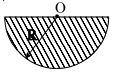
Moment of inertia of a thin semicircular disc (mass $= M$ & radius $= R$) about an axis through point $O$ and perpendicular to plane of disc, is given by :
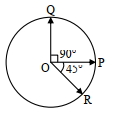
Three vectors $\overrightarrow{\mathrm{OP}}, \overrightarrow{\mathrm{OQ}}$ and $\overrightarrow{\mathrm{OR}}$ each of magnitude $A$ are acting as shown in figure. The resultant of the three vectors is $A \sqrt{x}$. The value of $x$ is. . . . . . . . .
A travelling microscope has $20$ divisions per $cm$ on the main scale while its Vernier scale has total $50$ divisions and $25$ Vernier scale divisions are equal to $24$ main scale divisions, what is the least count of the travelling microscope $..........\,cm$
A $2\, m$ long rod of radius $1\, cm$ which is fixed from one end is given a twist of $0.8$ radians. The shear strain developed will be
A body of mass $m_1$ exerts a force on another body of mass $m_2$. If the magnitude of acceleration of $m_2$ is $a_2$, then the magnitude of the acceleration of $m_1$ is (considering only two bodies in space)
A body is moving unidirectionally under the influence of a constant power source. Its displacement in time $t$ is proportional to :
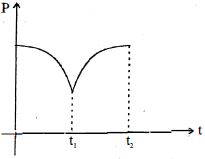
Graph between power and time is given below. Then which of the following option is correct for work done by force [from $t = 0$ to time $t$]
A symmetrical body of mass $M$ and radius $R$ is rolling without slipping on a horizontal surface with linear speed $v$. Then its angular speed is 
Assume there are two identical simple pendulum Clocks$-1$ is placed on the earth and Clock$-2$ is placed on a space station located at a height $h$ above the earth surface. Clock$-1$ and Clock$-2$ operate at time periods $4\,s$ and $6\,s$ respectively. Then the value of $h$ is $....km$ (consider radius of earth $R _{ E }=6400\,km$ and $g$ on earth $10\,m / s ^{2}$ )
An iron rod of length $2m$ and cross section area of $50\,m{m^2}$, stretched by $0.5\, mm$, when a mass of $250\, kg$ is hung from its lower end. Young's modulus of the iron rod is