MCQ
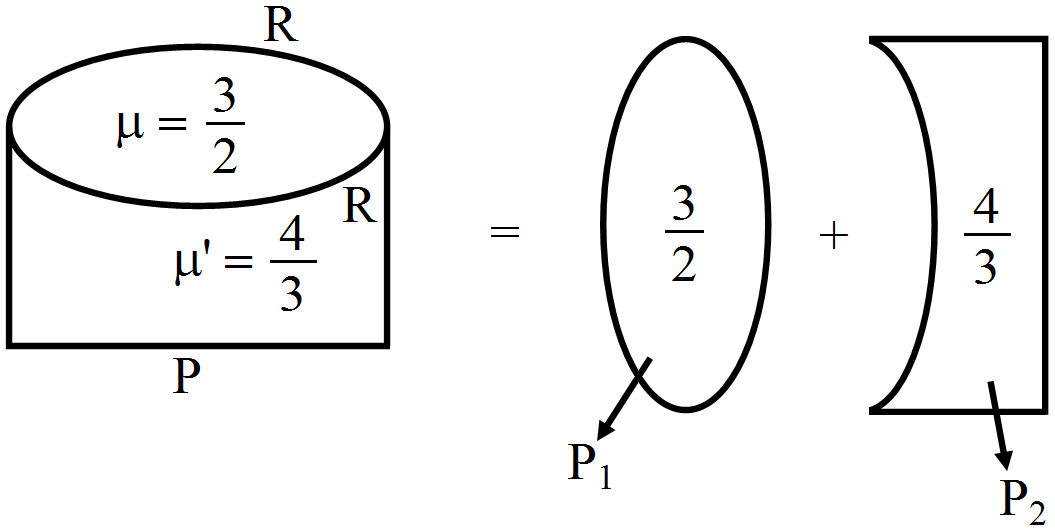
A thin lens is made with a material having refractive index $\mu=1.5.$ Both the sides are convex. It is dipped in water $(\mu=1.33).$ It will behave like:
  • A convergent lens.
  • B
    A divergent lens.
  • C
    A rectangular slab.
  • D
    A prism.

Answer

Correct option: A.
A convergent lens.

Here $P, P_1\ \&\ P_2$ are the power of Lenses.
$P = P_1 + P_2​​​​​​​$
$\frac{1}{\text{f}}=\frac{1}{\text{f}_1}+\frac{1}{\text{f}_2}$
$=(\mu-1)\Big(\frac{2}{\text{R}}\Big)+(\mu'-1)\Big(\frac{-1}{\text{R}}\Big)$
$=\Big(\frac{3}{2}-1\Big)\Big(\frac{2}{\text{R}}\Big)-\Big(\frac{4}{3}-1\Big)\Big(\frac{1}{\text{R}}\Big)$
$\frac{1}{\text{f}}=\frac{1}{\text{R}}-\frac{1}{3\text{R}}$
$\frac{1}{\text{f}}=\frac{3-1}{3\text{R}}$
$\text{f}=\frac{3\text{R}}{2}$
focal length of combined is positive means it will behave like a canvergent lens.

Need a full question paper?

Generate a complete, print-ready paper with questions like this in minutes — across 16+ boards, with answer keys.
Start Generating Free

Similar questions

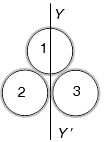
Three rings each of mass $M$ and radius $R$ are arranged as shown in the figure. The moment of inertia of the system about $YY' $ will be 
Two particles $A$ and $B$ are projected simultaneously from a fixed point of the ground. Particle $A$ is projected on a smooth horizontal surface with speed $v$, while particle $B$ is projected in air with speed $\frac{2 v}{\sqrt{3}}$. If particle $B$ hits the particle $A$, the angle of projection of $B$ with the vertical is
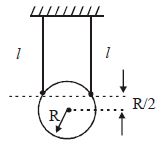
A disc of mass $m$ and radius $R$ is attached to celling with the help of ropes of length $l$. Find the time period of small oscillation of disc in the plane of disc.
A ring whose diameter is $1\ meter$, oscillates simple harmonically in a vertical plane about a nail fixed at its circumference. The time period will be ....... $\sec$.
In one dimensional motion, instantaneous speed $v$ satisfies $0\le\text{v}<\text{v}_0.$
A thin transparent sheet is placed in front of a Young's double slit. The fringe-width will:
A body is moving with velocity $1\ m/ s$ at a height $3m$ from the ground. What will be its speed at height $2m$ from the ground?
Two stones are thrown with same speed $u$ at different angles from ground in air. If both stones have same range and height attained by them are $h_1$ and $h_2$, then $h_1+h_2$ is equal to .......
The excess of pressure inside a soap bubble than that of the outer pressure is
rod of $40\, cm$ in length and temperature difference of ${80^o}C$ at its two ends. $A$ nother rod $B$ of length $60\, cm$ and of temperature difference ${90^o}C$, having the same area of cross-section. If the rate of flow of heat is the same, then the ratio of their thermal conductivities will be