Question
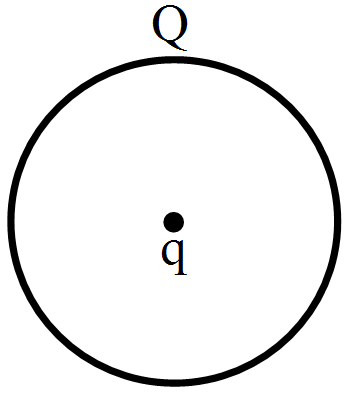
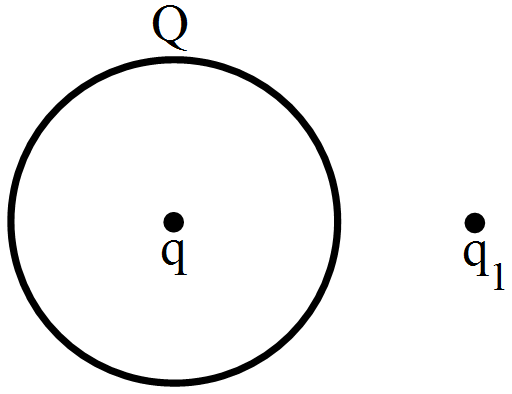
A thin, metallic spherical shell contains a charge Q on it. A point charge q is placed at the centre of the shell and another charge q1 is placed outside it as shown in figure. All the three charges are positive. The force on the charge at the centre is:
  1. Towards left.
  2. Towards right.
  3. Upward.
  4. Zero.

Answer

  1. Zero.

Explanation:

Electric field due to Q & q, inside the spherical shell is zero.

Need a full question paper?

Generate a complete, print-ready paper with questions like this in minutes — across 16+ boards, with answer keys.

Start Generating Free

Similar questions

The current in a coil changes from 4 ampere to zero in 0.1 s. If the average e.m.f. induced is 100 volt, what is the self inductance of the coil

(a) 2.5 H

(b) 25 H

(c) 400 H

(d) 40 H

Two nucleons are at a separation of 1 . The net force between them is , if both are neutrons,  if both are protons and   if one is a proton and other is a neutron. In such a case

(a)  

(b)  

(c)  

(d)  

Let Fpp, Fpn and Fnn denote the magnitudes of the net force by a proton on a proton, by a proton on a neutron and by a neutron on a neutron respectively. Neglect gravitational force. When the separation is 1fm:

The capacity of a parallel plate capacitor with no dielectric substance but with a separation of 0.4 cm is  2 μF. The separation is reduced to half and it is filled with a dielectric substance of value 2.8. The final capacity of the capacitor is

(a) 11.2 μF

(b) 15.6 μF

(c) 19.2 μF

(d) 22. 4 μF

Two light waves of equal amplitude and wavelength are super imposed. The amplitude of the resultant wave will be maximum when the phase difference between them is :
In an electromagnet, core is made of soft iron because:

Assertion  :   A laser beam 0.2 W power can drill holes through a metal sheet, whereas 1000 W torch-light cannot.   

Reason     : The frequency of laser light is much higher then that of torch light.

(a) If both assertion and reason are true and the reason is the correct explanation of the assertion.

(b) If both assertion and reason are true but reason is not the correct explanation of the assertion.

(c) If assertion is true but reason is false.

(d) If the assertion and reason both are false.

The de-Broglie wavelength l

(a) is proportional to mass

(b) is proportional to impulse

(c) Inversely proportional to impulse

(d) does not depend on impulse

A current of 1 mA is flowing through a copper wire.  How many electrons will pass a given point in one second [e = 1.6 × 10⁻¹⁹ Coulomb]

(a) 6.25 ×  

(b) 6.25 ×  

(c) 6.25 ×

(d) 6.25 ×  

E denotes electric field in a uniform conductor, I corresponding current through it,  drift velocity of electrons and P denotes thermal power produced in the conductor, then which of the following graph is incorrect

(a)

(b)

(c)

(d)