MCQ
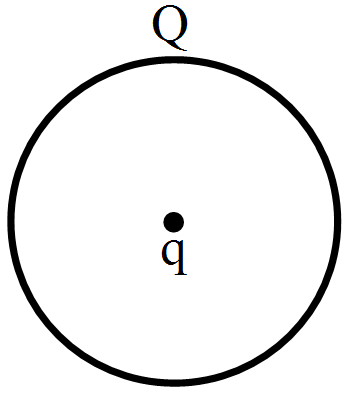
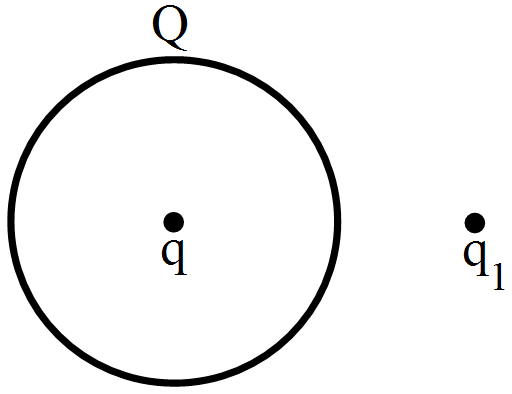
A thin, metallic spherical shell contains a charge $Q$ on it. A point charge q is placed at the centre of the shell and another charge $q_1$ is placed outside it as shown in figure. All the three charges are positive. The force on the charge at the centre is:
  • A
    Towards left.
  • B
    Towards right.
  • C
    Upward.
  • Zero.

Answer

Correct option: D.
Zero.


Electric field due to $Q\ \& \ q,$ inside the spherical shell is zero.

Need a full question paper?

Generate a complete, print-ready paper with questions like this in minutes — across 16+ boards, with answer keys.

Start Generating Free

Similar questions

A hollow metallic sphere of radius $R$ is given a charge $Q$. Then the potential at the centre is
The charge density in a nucleus varies with distance from the centre of the nucleus according to the curve in Fig.
The distance between charges $5 \times {10^{ - 11}}\,C$ and $ - 2.7 \times {10^{ - 11}}\,C$ is $0.2\, m$. The distance at which a third charge should be placed in order that it will not experience any force along the line joining the two charges is......$m$
A photoelectric cell is illuminated by a point source of light 1 m away. When the source is shifted to 2 m then
If the capacitance of each capacitor in the tetrahedron shown is $C$ , then effective capacitance of the network across any two junctions is ......$C$
The magnetic suceptibility of a material is $7.54 \times 10^{-3} .$ The nature and relative premeability of the substance is
A potentiometer having the potential gradient of 2 mV/cm is used to measure the difference of potential across a resistance of 10 ohm. If a length of 50 cm of the potentiometer wire is required to get the null point, the current passing through the 10 ohm resistor is (in mA)
A photo cell is a device which:
Consider the following statements and select the correct option:
  1. In an external electric field, the positive and negative charges of a non$–$polar molecule are displaced in opposite directions.
  2. In non $–$polar molecules displacement stops when the external force on the constituent charges of the molecule is balanced by the restoring force.
  3. The non$–$polar molecule develops an induced dipole moment.
If the radius of a coil is halved and the number of turns doubled, then the magnetic field at the centre of the coil, for the same current will