Question
A thin metallic spherical shell of radius R carries a charge Q on its surface. A point charge Q/2 is placed at the centre C, and another charge + 2Q is placed outside the shell at A at a distance x from the centre as shown in the figure.
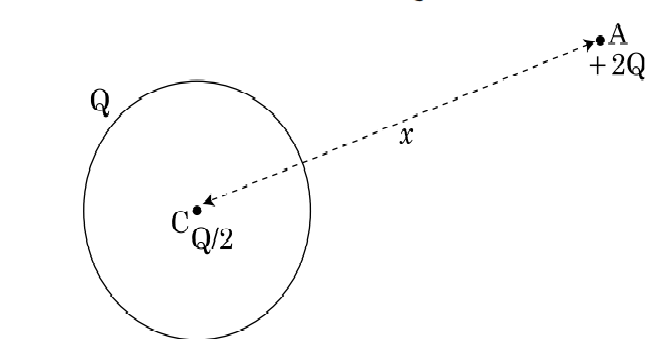
  1. Find the electric flux through the shell.
  2. State the law used.
  3. Find the force on the charges at the centre C of the shell and at the point A.
Answer

  1. Electric flux through a Gaussian surface,

$\varphi = \frac{\text{total enclosed charge }}{\in_{0}}$

Net charge enclosed inside the shell q = 0

$\therefore$ Electric flux through the shell $\frac{\text{q}}{\in_{o}} = 0 $

even when the student writes - Electric flux through the shell is zero as electric field inside the shell is zero.

  1. Gauss Law - Electric flux through a Gaussian surface is 1/∈0 times the net charge enclosed within it.

Alternate Answer

$\oint\overrightarrow{\text{E}}.\overrightarrow{\text{d}S} = \frac{\text{q}}{\text{E}_{o}}$

  1. Force on the charge at the centre i.e. Charges 𝑄/2 =0

$\text{F}_{A} = \frac{1}{4\pi\text{E}_{o}}\frac{2\text{Q}(\text{Q} + \text{Q} / 2)}{\text{x}^{2}}$

$ = \frac{1}{4\pi\text{E}_{o}}\frac{3\text{Q}^{2}}{\text{x}^{2}}$.

Need a full question paper?

Generate a complete, print-ready paper with questions like this in minutes — across 16+ boards, with answer keys.

Start Generating Free

Similar questions

In a p-n junction, a potential barrier of 250meV exists across the junction. A hole with a kinetic energy of 300meV approaches the junction. Find the kinetic energy of the hole when it crosses the junction if the hole approached the junction.
  1. From the p-side.
  2. From the n-side.
Write and explain Kirchhoff's loop rule
Explain, with the help of a schematic diagram, the principle and working of a Light Emitting Diode. What criterion is kept in mind while choosing the semiconductor material for such a device? Write any two advantages of Light Emitting Diode over conventional incandescent lamps.
Find the ratio of the lengths of an iron rod and an aluminium rod for which the difference in the lengths is independent of temperature. Coefficients of linear expansion of iron and aluminium are 12 × 10-6 °C-1 and 23 × 10-6 °C-1 respectively.
Consider the situation shown in figure Show that if the blocks are displaced slightly in opposite directions and released, they will execute simple harmonic motion. Calculate the time period.

Explain, with the help of a nuclear reaction in each of the following cases, how the neutron to proton ratio changes during (i) alpha-decay (ii) beta-decay?
A metallic rod of length l and resistance R is rotated with a frequency $\nu$ , with one end hinged at the centre and the other end at the circumference of a circular metallic ring of radius l, about an axis passing through the centre and perpendicular to the plane of the ring. A constant and uniform magnetic field B parallel to the axis is present everywhere.
i. Derive the expression for the induced emf and the current in the rod.
ii. Due to the presence of the current in the rod and of the magnetic field, find the expression for the magnitude and direction of the force acting on this rod.
iii. Hence obtain the expression for the power required to rotate the rod.
The. wire ABC shown in figure forms an equilateral triangle. Find the magnetic field B at the centre O of the triangle assuming the wire to be uniform.

Two charged conducting spheres of radii a and b are connected to each other by a wire. What is the ratio of electric fields at the surfaces of the two spheres? Use the result obtained to explain why charge density on the sharp and pointed ends of a conductor is higher than on its flatter portions.
What are reflecting type of telescope ? Explain the advantages and disadvantages of reflecting telescopes as compared to refracting telescope and also give the solution.