MCQ
A thin paper cup filled with water does not catch fire when placed over a flame. This is because
  • A
    the water cuts off oxygen supply to the paper cup
  • B
    water is an excellent conductor of heat
  • the paper cup does not become appreciably hotter than the water it contains
  • D
    paper is a poor conductor of heat

Answer

Correct option: C.
the paper cup does not become appreciably hotter than the water it contains
c
(c)

Thermal resistance of thin layer of paper is quite less, so heat reaches across the paper and water absorbs that heat. Temperature of paper does not rises beyond $100^{\circ} C$ and upto its burning temperature.

$\therefore$ Paper cup does not catches fire.

Need a full question paper?

Generate a complete, print-ready paper with questions like this in minutes — across 16+ boards, with answer keys.

Start Generating Free

Similar questions

A Carnot engine has efficiency $25\%$ . It operates between reservoirs of constant temperature with temperature difference of $80\,K$ . What is the temperature of low temperature reservoir ...... $^oC$
A particle is moving on a circular path with constant speed $v$. It moves between two points $A$ and $B$. which subtends an angle $60^{\circ}$ at the centre of circle. The magnitude of change in its velocity and change in magnitude of its velocity during motion from $A$ to $B$ are respectively ..........
Water has been filled in a vertical capillary tube upto the top after closing its lower end by a finger. If the finger is removed we shall observe that : ( $T = 70 \,\,dyne/cm,$  radus of capillary $r = 1\,\,mm$ and $g = 980\,\,cm/sec^2$ )
The moment of inertia of a solid cylinder about its axis is $I$. It is allowed to roll down an incline without slipping. If its angular velocity at the bottom be $\omega $, then $K.E.$ of the cylinder will be
Ice at $-20\,^oC$ is added to $50\,g$ of water at $40\,^oC.$ When the temperature of the mixture reaches $0\,^oC,$ it is found that $20\,g$ of ice is still unmelted. The amount of ice added to the water was close to ........$g$ (Specific heat of water $= 4.2\,J/g/^oC)$ Heat of fusion of water at $0^oC = 334\,J/g$ )
Preeti reached the metro station and found that the escalator was not working. She walked up the stationary escalator in time $t_1$ . On other days, if she remains stationary on the moving escalator, then the escalator takes her up in time $t_2$. The time taken by her to walk up on the moving escalator will be 
If the Bulk modulus of lead is $8.0 \times 10^9 \,N / m ^2$ and the initial density of the lead is $11.4 \,g / cc$, then under the pressure of $2.0 \times 10^8 \,N / m ^2$, the density of the lead is ............. $g / cc$
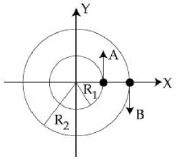
Two particles $A, B$ are moving on two concentric circles of radii $R_1$ and $R_2$ with equal angular speed $\omega $. At $t = 0,$ their positions and direction of motion are shown in the figure

The relative velocity $\overrightarrow {{V_A}}  - \overrightarrow {{V_B}} $ at $t = \frac{\pi }{{2\omega }}$ is given by

Two discs of moments of inertia $I_1$ and $I_2$ about their respective axes (normal to  the disc and passing through the centre), and rotating with angular speed $\omega _1$ and $\omega _2$ are  brought into contact face to face with their axes of rotation coincident. What is the  loss in kinetic energy of the system in the process ?
An open pipe of length $33 cm$ resonates with frequency of $100 Hz$. If the speed of sound is $330 m/s$, then this frequency is