MCQ
A thin spherical insulating shell of radius $R$ carries a uniformly distributed charge such that the potential at its surface is $V _0$. A hole with a small area $\alpha 4 \pi R ^2(\alpha<<1)$ is made on the shell without affecting the rest of the shell. Which one of the following statements is correct?
  • The ratio of the potential at the center of the shell to that of the point at $\frac{1}{2} R$ from center towards the hole will be $\frac{1-\alpha}{1-2 \alpha}$
  • B
    The magnitude of electric field at the center of the shell is reduced by $\frac{\alpha V_0}{2 R}$
  • C
    The magnitude of electric field at a point, located on a line passing through the hole and shell's center on a distance $2 R$ from the center of the spherical shell will be reduced by $\frac{\alpha V_0}{2 R}$
  • D
    The potential at the center of the shell is reduced by $2 \alpha V _0$
Answer

Correct option: A.
The ratio of the potential at the center of the shell to that of the point at $\frac{1}{2} R$ from center towards the hole will be $\frac{1-\alpha}{1-2 \alpha}$
a
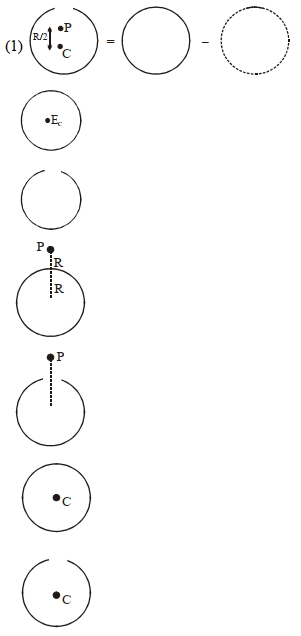
Let charge on the sphere initially be $Q$.

$\therefore \frac{ kQ }{ R }= V _0$

and charge removed $=\alpha Q$

(image)

and $V _{ p }=\frac{ kQ }{ R }-\frac{2 K \alpha Q }{ R }=\frac{ kQ }{ R }(1-2 \alpha)$

$V _{ c }  =\frac{ kQ (1-\alpha)}{ R }$

$\therefore \frac{ V _{ c }}{ V _{ p }}  =\frac{1-\alpha}{1-2 \alpha}$

$(2)$ $\left( E _{ C }\right)_{\text {inritial }}=$ zero

$\left(E_c\right)_{\text {fimal }}=\frac{k \alpha Q}{R^2}$

$\Rightarrow$ Electric field increases

(image)

$(3)$ $\left( E _{ p }\right)_{\text {iritizl }}=\frac{ kQ }{4 R ^2}$

$\left( E _{ P }\right)_{\text {fimel }}=\frac{ kQ }{4 R ^2}-\frac{ k \alpha Q }{ R ^2}$

$\Delta E _{ p }=\frac{ kQ }{4 R ^2}-\frac{ kQ }{4 R ^2}+\frac{ k \alpha Q }{ R ^2}=\frac{ k \alpha Q }{ R ^2}=\frac{ V _0 \alpha}{ R }$

(image)

(4) $\left(V_c\right)_{\text {minitil }}=\frac{k Q}{R}$

$\left(V_c\right)_{\text {finel }}=\frac{k Q(1-\alpha)}{R}$

$\Delta V_C=\frac{k Q}{R}(\alpha)=\alpha V_0$  (image)

Need a full question paper?

Generate a complete, print-ready paper with questions like this in minutes — across 16+ boards, with answer keys.

Start Generating Free

Similar questions

Which state of triply ionised Baryllium $(B{e^{ + + + }})$ has the same orbital radius as that of the ground state of hydrogen
The wettability of a surface by a liquid depends primarily on
A transistor-oscillator using a resonant circuit with an inductor $L$ (of negligible resistance) and a capacitor $C$ in series produce oscillations of frequency $f$. If $L$ is doubled and $C$ is changed to $4C,$ the frequency will be 
A wire of $9.8 \times {10^{ - 3}}kg{m^{ - 1}}$ passes over a frictionless light pulley fixed on the top of a frictionless inclined plane which makes an angle of $30°$ with the horizontal. Masses $m$ and $M$ are tied at the two ends of wire such that $m$ rests on the plane and $M$ hangs freely vertically downwards. The entire system is in equilibrium and a transverse wave propagates along the wire with a velocity of $100 ms^{-1}$. Chose the correct option $m =$ ..... $kg$
A simple pendulum of length $L$ and mass (bob) $M$ is oscillating in a plane about a vertical line between angular limits $ - \varphi $ and $ + \varphi $. For an angular displacement $\theta (|\theta | < \varphi )$, the tension in the string and the velocity of the bob are $T$ and $ v$ respectively. The following relations hold good under the above conditions
The coefficient of mutual inductance of two coils is $6\, mH$. If the current flowing in one is $2$ $ampere$, then the induced $e.m.f$. in the second coil will be
The dimension of $\sqrt{\frac{\mu_{0}}{\in_{0}}}$ is equal to that of :
( $\mu_{0}=$ Vacuum permeability and $\in_{0}=$ Vacuum permittivity)
$A$ disc of radius $R$ is rolling purely on a flat horizontal surface, with a constant angular velocity. The angle between the velocity and acceleration vectors of point $P$ is
The latent heat of vaporization of water is $2240 \,J/gm$. If the work done in the process of vaporization of $1\, gm$ is $168\, J$, then increase in internal energy is  .... $J$
A photo-emissive substance is illuminated with a radiation of wavelength $\lambda_{i}$ so that it releases electrons with de-Broglie wavelength $\lambda_{e}$. The longest wavelength of radiation that can emit photoelectron is $\lambda_{0}$. Expression for de-Broglie wavelength is given by :
( m : mass of the electron, h : Planck's constant and c : speed of light)