MCQ
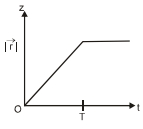
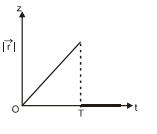
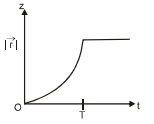
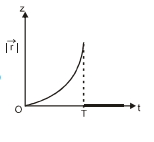
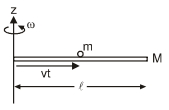
A thin uniform rod, pivoted at $O$, is rotating in the horizontal plane with constant angular speed $\omega$, as shown in the figure. At time, $t =0$, a small insect starts from $O$ and moves with constant speed $v$ with respect to the rod towards the other end. It reaches the end of the rod at $t = T$ and stops. The angular speed of the system remains $\omega$ throughout. The magnitude of the torque $(|\vec{\tau}|)$ on the system about $O$, as a function of time is best represented by which plot?
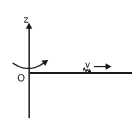
  • A


  • C

  • D

Answer

Correct option: B.

b
$ L =\left[ m ( vt )^2\right] \omega $

$L $$ = mv ^2 \omega t ^2 $

$\text { So } \quad \tau $$=\frac{ dL }{ dt }=2 m v^2 \omega t $

$ \tau \propto t $

$\Rightarrow \quad \begin{array}{l}\tau \propto t \\ \text { straight line passing through }(0,0)\end{array}$

Need a full question paper?

Generate a complete, print-ready paper with questions like this in minutes — across 16+ boards, with answer keys.

Start Generating Free

Similar questions

A ball is projected from the ground at an angle of $45^{\circ}$ with the horizontal surface. It reaches a maximum height of $120 m$ and returns to the ground. Upon hitting the ground for the first time, it loses half of its kinetic energy. Immediately after the bounce, the velocity of the ball makes an angle of $30^{\circ}$ with the horizontal surface. The maximum height it reaches after the bounce, in metres, is. . . . .
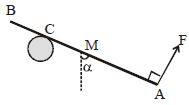
A uniform rod $AB$ of weight $100\, N$ rests on a rough peg at $C$ and $a$ force $F$ acts at $A$ as shown in figure. If $BC = CM$ and tana $= 4/3$. The minimum coefficient of friction at $C$ is
Hydrogen gas and oxygen gas have volume $1 \,\,cm^3$ each at $N.T.P$.
A body is moving on a circle of radius $80 \,m$ with a speed $20 \,m / s$ which is decreasing at the rate $5 \,m / s ^2$ at an instant. The angle made by its acceleration with its velocity is ..........
A solid sphere falls with a terminal velocity of 20m/s in air. If it is allowed to fall in vacuum,
  1. Terminal velocity will be 20m/s
  2. Terminal velocity will be less than 20m/s
  3. Terminal velocity will be more than 20m/s
  4. There will be no terminal velocity.
Surface tension of soap solution is $ 2 ×10^{-2} N/m$. The work done in producing a soap bubble of radius $2 \,cm$ is
Two simple pendulums of length $0.5\, m$ and $2.0\, m$ respectively are given small linear displacement in one direction at the same time. They will again be in the phase when the pendulum of shorter length has completed .... oscillations.
Two rectangular blocks $A$ and $B$ of different metals have same length and same area of cross-section. They are kept in such a way that their cross-sectional area touch each other. The temperature at one end of $A$ is $100°C$ and that of $B$ at the other end is $0°C$ . If the ratio of their thermal conductivity is $1 : 3$ , then under steady state, the temperature of the junction in contact will be ........ $^oC$
The first law of thermodynamics is a statement of:
  1. Conservation of heat.
  2. Conservation of work.
  3. Conservation of momentum.
  4. Conservation of energy.
In uniform circular motion, the velocity vector and acceleration vector are