MCQ
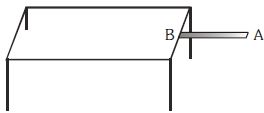
A thin uniform stick of length $l$ and mass $m$ is held horizontally with its end $B$ hinged on the edge of a table. Point $A$ is suddenly released. The acceleration of the centre of mass of the stick at the time of release, is
  • $\frac{3}{4}\,g$
  • B
    $\frac{3}{7}\,g$
  • C
    $\frac{2}{7}\,g$
  • D
    $\frac{1}{7}\,g$

Answer

Correct option: A.
$\frac{3}{4}\,g$
a
$\tau=\operatorname{mg} \times \frac{\ell}{2} \quad$ and $\tau=I \alpha$

also $a$ $=\alpha r$

$=\frac{\tau}{\mathrm{I}} \times \frac{\ell}{2}=\frac{\mathrm{mg}}{\frac{\mathrm{m} \ell^{2}}{3}} \times \frac{\ell}{2} \times \frac{\ell}{2}=\frac{3}{4} \mathrm{g}$

Need a full question paper?

Generate a complete, print-ready paper with questions like this in minutes — across 16+ boards, with answer keys.

Start Generating Free

Similar questions

Two forces of magnitude $F$ have a resultant of the same magnitude $F$. The angle between the two forces is ........ $^o$
A uniform heavy rod of mass $20\,kg$. Cross sectional area $0.4\,m ^{2}$ and length $20\,m$ is hanging from a fixed support. Neglecting the lateral contraction, the elongation in the rod due to its own weight is $x \times 10^{-9} m$. The value of $x$ is

(Given. Young's modulus $Y =2 \times 10^{11} Nm ^{-2}$ અને $\left.g=10\, ms ^{-2}\right)$

A musical scale is constructed by providing intermediate frequencies between a note and its octave which
A thin rod of mass $m$ and length $l$ is oscillating about horizontal axis through its one  end. Its maximum angular speed is $\omega$. Its centre of mass will rise upto maximum  height :-
A soldier with a machine gun, falling from an alrplane gets detached from his parachute. He is able to resist the downward acceleration, if he shoots $40$ bullets a second at the speed of $500 \,m / s$. If the weight of a bullet is $49 \,g$, the weight of the man .......... $ \,kg$ with the gun? Ignore resistance due to air and assume the acceleration due to gravity, $g=9.8 \,ms ^{-2}$.
During projectile motion the quantities that remain unchanged are:
A normal eye is not able to see objects closer than 25cm because:
A progressive wave travelling along the positive $x-$ direction is represented by $y(x, t) = A\,sin\,\left( {kx - \omega t + \phi } \right)$. Its snapshot at $t = 0$ is given in the figure For this wave, the phase $\phi $ is
A physical quantity $A$ is related to four observable $a,b,c$ and $d$ as follows, $A = \frac{{{a^2}{b^3}}}{{c\sqrt d }}$, the percentage errors of measurement in $a,b,c$ and $d$ are $1\%,3\%,2\% $ and $2\% $ respectively. What is the percentage error in the quantity $A$ ......... $\%$
When a train stops suddenly, passengers in the running train feel an instant jerk in the forward direction because