A torch battery consisting of two cells of $1.45\, volts$ and an internal resistance $0.15\,\Omega $, each cell sending currents through the filament of the lamps having resistance $1.5\,ohms$. The value of current will be ....... $A$
Medium


Download our appand get started for free
Experience the future of education. Simply download our apps or reach out to us for more information. Let's shape the future of learning together!No signup needed.*
Similar Questions
- 1A current of $10\, A$ exists in a wire of crosssectional area of $5\, mm ^{2}$ with a drift velocity of $2 \times 10^{-3}\, ms ^{-1}$. The number of free electrons in each cubic meter of the wire is ..........View Solution
- 2The combination of two identical cells, whether connected in series or parallel combination provides the same current through an external resistance of $2 \,\Omega$. The value of internal resistance of each cell is ............ $\Omega$View Solution
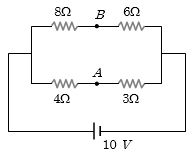
- 3The potential difference between point $A$ and $B$ is ............. $V$View Solution
- 4View SolutionThe resistivity of a wire
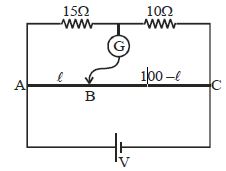
- 5In the meter bridge shown, the length $AB$ for which the deflection in galvanometer is zero will be ............. $cm$View Solution
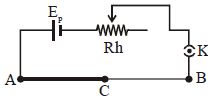
- 6A potentiometer consists of two wires $AC$ and $CB$ of same material and of equal lengths but diameters in the ratio $3 : 1.$ Then the potential gradients on the two wires will be in the ratio :-View Solution
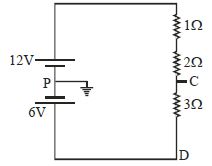
- 7Find potential at point $C$ and $D$View Solution
- 8A uniform metallic wire has a resistance of $18\,\Omega $ and is bent into an equilateral triangle. Then, the resistance between any two vertices of the triangle is .................. $\Omega$View Solution
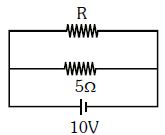
- 9The power dissipated in the circuit shown in the figure is $30\, Watts$. The value of $R$ is ............. $\Omega$View Solution
- 10Three resistances of one ohm each are connected in parallel. Such connection is again connected with $\frac{2}{3}\,\Omega $ resistor in series. The resultant resistance will be ........... $\Omega$View Solution