Question
A torch is not functioning, though contact points in the torch are in working condition. What can be the possible reasons for this? Mention any three.

Answer

The possible reasons for not functioning of torch are:
  1. The torch bulb may be fused.
  2. The cells may be discharged.
  3. The connecting wires may be broken up.
  4. The cells may not be placed in the correct order.
  5. The switch is faulty.

Need a full question paper?

Generate a complete, print-ready paper with questions like this in minutes — across 16+ boards, with answer keys.

Start Generating Free

Similar questions

Beautiful hand crafted articles like boxes and toys are made of paper pulp in our country. Can you explain how paper pulp which is made from paper can be used to make hard boxes and other articles?
Read the following paragraph and fill in the blanks using the words you unscrambled.
______$(a)$______ and ______$(b)$______ form the skeleton of the human body. They provide the framework, give ______$(c)$______ to the body and help in ______$(d)$______ They protect the ______$(e)$______ The bones are moved by alternate ______$(f)$______ and ______$(g)$______ of two sets of ______$(h)$______ attached to them.
Directions: Read the passage $(s)$ given below and answer the questions that follow. Passage - $1$ Look at the following food chain and then answer the questions that follow. Grain $\rightarrow $ grasshopper $\rightarrow $ frogs $\rightarrow $ snakes $\rightarrow $ owls bacteria Which organism in this food chain is responsible for recycling nutrients?
  1. Snakes.
  2. Bacteria.
  3. Owls.
  4. Grasshopper.
You are given an iron strip. How will you make it into a magnet?
Match the following items given in Column $A$ with that in Column $B$:
 
S.No.
Column $A$
S.No.
Column $B$
$(a)$
Jute is obtained from.
$(i)$
Charkha.
$(b)$
Fibre from retted jute are extracted by.
$(ii)$
Sliver.
$(c)$
Separation of fibres from jute stem.
$(iii)$
Bales.
$(d)$
Compressed bundles of cotton.
$(iv)$
Retting.
$(e)$
Cotton is collected from cotton plants by.
$(v)$
Hand picking.
$(f)$
Separation of cotton from seeds.
$(vi)$
Silk and wool.
$(g)$
Loose rope of cotton fibres.
$(vii)$
Stem of‘putson.
$(h)$
Animal fibres.
$(viii)$
Hands with jerks and pulls.
$(i)$
Suitable for wearing in kitchen.
$(ix)$
Ginning.
$(j)$
Used to spin yams.
$(x)$
Cotton clothes.
Match the mixtures in Column $I$ with their method of separation in Column $II$.
 
$COLUMN\ I$
 
$COLUMN\ II$
$a$
Oil mixed in water
$i$
Sieving
$b$
Iron powder mixed with flour
$ii$
Hand picking
$c$
Salt mixed with water
$iii$
Decantation
$d$
Lady's finger mixed with french beans
$iii$
Magnet
$e$
Rice flour mixed with kidney beans
$iv$
Evaporation
Match the following items given in Column $A$ with that in Column $B$:
S.No.
Column $A$
S.No.
Column $B$
$(a)$
Creeper
$(i)$
Absorption of mineral and water.
$(b)$
Herb
$(ii)$
Manufacture food.
$(c)$
Shrub
$(iii)$
Transport food, water and mineral.
$(d)$
Tree
$(iv)$
Reproduction.
$(e)$
Root
$(v)$
Need support to stand up.
$(f)$
Stem
$(vi)$
Hard and thick stem.
$(g)$
Leaf
$(vii)$
Green and tender stem.
$(h)$
Flower
$(viii)$
Hard but thin stem.
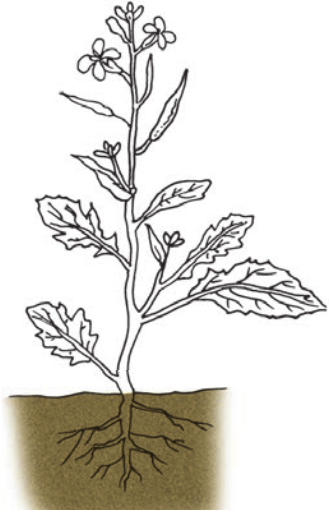
Read the function of parts of a plant given below:
  1. Fixes plant to the soil.
  2. Prepares starch.
  3. Takes part in reproduction.
  4. Supports branches and bears flowers.
In the diagram given in fig, write the names of the parts whose functions you have just read at the appropriate space.
Activity.Place a chair in the school ground on a sunny day. What do you observe from the shadow of the chair?
  1. Does the shadow give an accurate picture of the shape of the chair? If the chair is turned around a little, how does the shape of the shadow change?
  2. Take a thin notebook and look at its shadow. Then, take a rectangular box and look at its shadow. Do the two shadows seem to have a similar shape?
  3. Take flowers or other objects of different colours and look at their shadows. A red rose and a yellow rose, for instance. Do the shadows look different in colour, when the colours of the objects are different?
  4. Take a long box and look at its shadow on the ground. When you move the box around, you may see that the size of the shadow changes. When is the shadow of the box the shortest, when the long side of the box is pointed towards the Sun or when the short side is pointing towards the Sun?
Can you think of creating a shape that would give a circular shadow if held in one way and a rectangular shadow if held in another way?