Question
A torsional pendulum consists of a solid disc connected to a thin wire$\Big(\alpha=2.4\times10^{-5}\ ^\circ\text{C}^{-1}\Big)$at its centre. Find the percentage change in the time period between peak winter (5°C) and peak summer (45°C).

Answer

Let the initial m.I. at 0°C be $\text{I}_0$

$\text{T}=2\pi\sqrt\frac{\text{I}}{\text{K}}$

$\text{I}=\text{I}_0(1+2\alpha\Delta\theta)$ (from above question)

At 5°C, $\text{T}_1=2\pi\sqrt\frac{\text{I}_0(1+2\alpha\Delta\theta)}{\text{K}}$

$=2\pi\sqrt\frac{\text{I}_0(1+2\alpha\Delta5)}{\text{k}}$

$=2\pi\sqrt\frac{\text{I}_0(1+10\alpha)}{\text{K}}$

At 45°C, $\text{T}_2=2\pi\sqrt\frac{\text{I}_0(1+2\alpha45)}{\text{K}}$

$2\pi\sqrt\frac{\text{I}_0(1+90\alpha)}{\text{K}}$

$\frac{\text{T}_2}{\text{T}_1}=\sqrt\frac{1+90\alpha}{1+10\alpha}$

$=\sqrt\frac{1+90\times2.4\times10^{-5}}{1+10\times2.4\times10^{-5}}\sqrt\frac{1.00216}{1.00024}$

% change $=\Big(\frac{\text{T}_2}{\text{T}_1}-1\Big)\times100$

$=0.0959\%=9.6\times10^{-2}\%$

Need a full question paper?

Generate a complete, print-ready paper with questions like this in minutes — across 16+ boards, with answer keys.
Start Generating Free

Similar questions

A man whirls a stone round his head on the end of a string 4m long. Can the string be in a horizontal plane? If the stone has a mass of 0.4kg, and the string will break if the tension in it exceed 8N, what is the smallest angle the string can make with the horizontal ? What is the speed of the stone? (take g = 10ms-2)
Three equal masses m are placed at the three corners of an equilateral triangle of side a. Find the force exerted by this system on another particle of mass m placed at,
  1. The mid-point of a side,
  2. At the centre of the triangle.
A spherical tungsten piece of radius 1.0cm is suspended in an evacuated chamber maintained at 300K. The piece is maintained at 1000K by heating it electrically. Find the rate at which the electrical energy must be supplied. The emissivity of tungsten is 0.30 and the Stefan constant $\sigma$ is 6.0 × 10-8Wm-2K-4.
Two discs of moments of inertia I1 and I2 about their respective axes (normal to the disc and passing through the centre), and rotating with angular speed $\omega_1$ and $\omega_2$ are brought into contact face to face with their axes of rotation coincident.
  1. Does the law of conservation of angular momentum apply to the situation? why?
  2. Find the angular speed of the two-disc system.
  3. Calculate the loss in kinetic energy of the system in the process.
  4. Account for this loss.
During a total solar eclipse the moon almost entirely covers the sphere of the sun. Write the relation between the distances and sizes of the sun and moon.
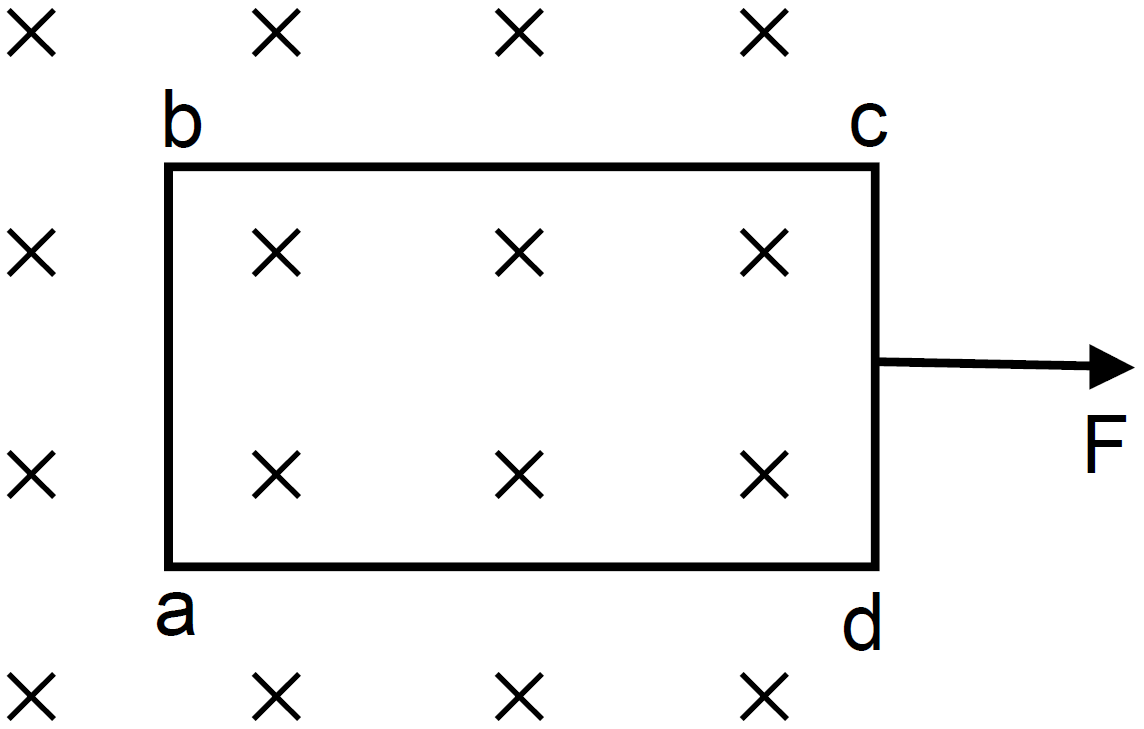
A rectangular frame of wire abcd has dimensions 32cm × 8.0cm and a total resistance of $2.0\Omega.$ It is pulled out of a magnetic field B = 0.020T by applying a force of 3.2 × 10⁻⁵N (figure). It is found that the frame moves with constant speed. Find
  1. This constant speed.
  2. The emf induced in the loop.
  3. The potential difference between the points a and b.
  4. The potential difference between the points c and d.

Find the component of $\vec{\text{a}}=2\hat{\text{i}}+3\hat{\text{j}}$ along the directions of vectors $\hat{\text{i}}+\hat{\text{j}}$ and $\hat{\text{i}}-\hat{\text{j}}.$
A motor car moving at a speed of 72km/h can not come to a stop in less than 3.0s while for a truck this time interval is 5.0s. On a higway the car is behind the truck both moving at 72km/h. The truck gives a signal that it is going to stop at emergency. At what distance the car should be from the truck so that it does not bump onto (collide with) the truck. Human response time is 0.5s.
Derive an equation for the distance covered by a uniformly accelerated body in nth second of its motion. A body travels half its total path in the last second of its fall from rest. Calculate the time of its fall.
A wave travelling on a string, at a speed of 10m/s causes each particle of the string to oscillate with a time period of 20ms.
  1. What is the wavelength of the wave?
  2. If the displacement of a particle is 1.5mm at a certain instant, what will be the displacement of a particle 10cm away from it at the same instant?